# Movement Assemblies
Using the Community Assembly format to 'walk the talk' within XRUK to involve all rebels in participatory democracy.
# What are Movement Assemblies?
Based on the [Community Assembly](https://rebeltoolkit.extinctionrebellion.uk/books/community-assemblies) format, the UK Assemblies team will support our movement to continue **walking the talk** and to flex and strengthen our democracy muscles. You are invited to be part of that process by helping to suggest and choose the topic for our first Movement Assembly.
**Assemblies are a beautiful way to bring our collective wisdom to resolve our toughest issues.**
To enhance the Movement Assemblies and get the best from this process, we're using an online **interactive**, democratic voting platform called Polis ([more info here](https://rebeltoolkit.extinctionrebellion.uk/books/guide-to-polis/page/what-is-polis)). Polis is used all over the world by governments, academics, independent media and citizens for more inclusive decision-making. It is described as, "A real-time system for gathering, analysing and understanding what large groups of people think in their own words."
We know that when people come together in trust and love we make fairer, more inclusive, creative and transparent decisions.
# Preparing for a Movement Assembly
### Facilitators and Note-takers
We are always looking for facilitators for small breakout room discussions, especially via our Assemblies Sharing chat.
Potential facilitation or note-taker volunteers can watch the Assembly Facilitation training via recorded video.
Please note, we are not offering guidance on note-taking, given different styles of everyone. We appreciate that this role is, however, perhaps more difficult than facilitation. Some note-takers want to write full, verbatim records; others will paraphrase to enable simpler, faster analysis at the priority finding stage of deliberation. Some organisers now use software, such as 'Dembrane' to record discussions, which ensures transparency and more accurate reporting.
**Contact us to volunteer as an Assembly Facilitator** (or to ask questions, stating whether you’re already trained or experienced) at [assemblies@extinctionrebellion.uk](mailto:assemblies@extinctionrebellion.uk).
### Assembly Process
The first section before the breakout rooms, will usually be recorded. After the assembly, this will be shared for those that couldn’t attend but want to see the process and also take part in voting after the assembly. There is a [recording and more info](https://rebeltoolkit.extinctionrebellion.uk/link/1840#bkmrk-page-title) from the first Movement Assembly that took place on 27th July 2025 .
##### What Happens in the Breakout Rooms
- Once in the small breakout rooms, the group can decide on breaks and when these will be, or if you need a comfort break at any time, let the facilitator know.
* Each breakout room will have a facilitator (F) and note-taker (N). If the breakout room doesn't have someone with an F or N before their name, the participants need to decide who will take on these roles.
- **Note-takers will record the group's contributions using a harvest doc**. Volunteers for note-taker should join the assembly on a computer or tablet and not on a phone. They should ask people to slow down when needed to make sure contributions are recorded accurately.
* Facilitators are also advised to join using a computer or tablet as this makes the task much easier.
- Facilitators are there to support the group and to make sure everyone’s voices are heard. **Please respect the process and use [hand signals](https://rebeltoolkit.extinctionrebellion.uk/link/1864#bkmrk-page-title) when contributing to the discussions**. Facilitators can explain the hand signals to the breakout room participants.
* Timings for an hour and a half breakout room are likely to be:
- 75 minutes for the main discussion.
- 15 minutes to identify your three top ideas.
- The note-taker will then read the 3 ideas back to the group for agreement. Once the group is happy, the note-taker will enter the group's 3 ideas into Polis.
##### How Will Polis be Used?
- The Polis Moderators then check the submissions to make sure personally identifiable information isn't included, e.g. names, email addresses, telephone numbers etc.
* Polis will then open for voting for a week, usually from midday on the Tuesday (if Assembly runs on a Sunday). Everyone will be able to vote on all the groups’ top 3 ideas over the following week.
- The Polis results from this round of voting will be published on the Rebel Toolkit and everyone who registered for the Assembly will get these via email.
Any questions? [Contact the UK Assemblies Team](https://rebeltoolkit.extinctionrebellion.uk/books/guide-to-assemblies/page/assemblies-team-training).
If you find any of these processes confusing or overwhelming, need adaptations, a buddy or have other access needs, please do contact wellbeing at or 07773 193704.
# Movement Assembly #1
The first Movement Assembly took place in summer 2025
# The Process
##### How the question was chosen by the movement
- Week 1 Sat 28 June - Fri 4 July: Rebels submitted ideas for movement assembly topics via Polis.
- Week 2 Sat 5 July - Fri 11 July: Everyone got the chance to vote on everyone's ideas via Polis.
- Polis results: Comments and votes made were processed by the Assemblies team to determine the question for the Movement Assembly #1, with Data Analysis & Insights Circle's support.
##### The Question - "How might we effectively engage and activate more people in the climate and nature crises?"
- Sun 27 July: Movement Assembly #1 (online)
You can watch the recording (46mins) of the first part of the assembly. This recording allowed anyone who could not attend the Zoom-based assembly to take part subsequently, voting on the ideas generated via Polis.
##### After the assembly
- Tues 29 July - Tues 5 Aug: Voted on the outcomes of the assembly via Polis.
##### Links shared during the assembly
The first part of the movement assembly saw a variety of speakers from XRUK teams. The following links were shared to help people learn more about those team's work:
- Intro music "People Have the Power"
- Outreach
- Sign up to hear from XR Outreach about training.
- [Outreach including Survey Boards on the Rebel Toolkit](https://xrb.link/dg3NfK3a)
- Britain Talks Climate
- Heard: ‘Climate Stories That Work’
- Prefigurative Politics in Practice
- Community Building
- [Community Building Book on the Rebel Toolkit](https://xrb.link/Y0A0Q845)
- Strategy
- [XRUK Strategy on the Rebel Toolkit](https://xrb.link/tV6V4ZK1)
Details of the three week process to choose the question
##### In Week One ...
**Sat 28 June - Fri 4 July**
**Over 600 ideas** were gathered from almost 480 people throughout the week Polis was open for participation.
Duplicated ideas for topics were edited out by Moderators to minimise overwhelm and frustration of participants. However, the breadth of issues people want to discuss means everyone taking part saw many possible ideas to vote on. See [Moderation info](https://rebeltoolkit.extinctionrebellion.uk/link/1856#bkmrk-moderation)
##### In Week Two...
**Sat 5 - Fri 11 July**
Everyone voted on the topics that were submitted in the first week.
A pre-agreed moderation process was followed by the organisers in XRUK Assemblies team. Some duplications were merged and some sentences rephrased to statements which left **588 ideas to vote on.**
Assemblies sent out the message that anyone taking part didn't need to vote on every idea. Polis works its magic even if you only vote on 20 ideas of 588. The tight schedule of messaging meant this message may not have fully landed, however.
A [Guide: Polis for Participants](https://rebeltoolkit.extinctionrebellion.uk/link/1856#bkmrk-page-title) was shared with rebels to help them better understand the process and to help them make the most out of taking part in deciding the topic for our first Movement Assembly, by voting on everyone's submissions.
##### In Week Three...
- Polis identified the most popular ideas for topics which to be the basis for a Movement Assembly.
- XRUK Assemblies [the Assembly Organisers on this occasion] then supported, coordinated and publicised this first Movement Assembly.
- Results are here on the Rebel Toolkit and were publicised on the Rebellion Broadcast. Data from the Polis used for choosing the question
#### Polis Report
- The full Polis Report. Please note: you will not be able to download the 'raw data' from any Polis exercise, given risk to privacy of participants.
#### Explainer: How Polis Works | Groups and Their Opinions
Polis's algorithms takes the data (ie statements inputted and participant responses to these), then breaks the participants down into groups of people whose opinions converge or differ significantly. This does not mean that they don’t agree on anything, but more that their priorities lie in different places.
In July 2025, it found three distinct groups (A, B and C, seen in the results breakdown).
Their opinions can be broadly defined as:
- A (**43 people; 3%**) – in general voted negatively on most issues and passed on few statements. However, they showed support for discussing XR internal **strategy, actions and reform**. This offers scope to explore the tensions held by this group in relation to those aspects of how we work, either in a subsequent assembly or Polis exercise.
- B (**135 people; 11%**) – in general voted positively on most issues and passed little. They showed strongest support for discussing questions around **structural and political change and engaging the public in the climate movement**.
- C (**1068 people; 86%**) – in general voted positively on most issues, but passed regularly. They showed strongest support for discussing **how to engage large numbers of people in the climate movement**.
#### How To Use the Data to Gain Insights
At the bottom of the report under the 'All Statements' section, the results (ie responses to statements inputted to Polis) are displayed for all participants `OVERALL` and broken down by group (A, B, C) for every statement.
You can select the drop-down arrow next to 'Sort by': and choose different options to display the info according to what you find most interesting. Two of the most useful options **to gain insights into perspectives of participants** are **`Number of votes`** and **`% Agreed`**.
#### Overall Results
- The Overall results are most closely aligned to those of Group C, who made up 86% of respondents
- Those in Group B felt more strongly positive about the Top 10 statements
- Group A felt more negative/mixed.
The aim of Polis is to allow the statements upon which most people are likely to agree ‘rise to the top’; it does this via algorithms which analyse initial responses coming in. In this case, the **themes that most closely align with the majority of those participating were around engaging the wider public in the climate fight.**
#### Summary
[](https://rebeltoolkit.extinctionrebellion.uk/uploads/images/gallery/2025-07/screenshot-2025-07-13-122420.png)
- The UK Assemblies team involved relevant teams to co-create the question for our first Movement Assembly.
- We then got to deliberate on that question at this first Movement Assembly.
#### How we prepared for the assembly
Details of how we [prepared for the Assembly](https://rebeltoolkit.extinctionrebellion.uk/link/1964#bkmrk-page-title) included:
- Compiling descriptions of each step of the assembly into guidance documents for eg Participants, organisers, moderators.
- Explained - albeit with more limited understanding at the time - how Polis would be used post-assembly. We used the Rebellion Broadcast as our main communication tool to get messages out about the various stages. In the process, we have created template RB messages to use in future.
- We called out via the Rebellion Broadcast and via the Assemblies Sharing channels for anyone to consider volunteering as a Facilitator or Note-taker for the Assembly. We were mostly successful in finding volunteers who had some assembly support experience.
- XRUK Assemblies team set up drop-in sessions in advance for anyone considering attending or supporting the assembly for a chat and to seek support.
- We liaised throughout with the Disabled Rebels Network to ensure maximum participation, engagement and enjoyment of participants, whatever their circumstances.
Optional Pre-Reading Provided
This was a list of things that the Assemblies team thought people could find helpful before joining the assembly.
- Our Story | Strategic communications guidance for Extinction Rebellion UK April 2025
* XRUK Strategic Comms Presentation Sept 2024
- XRUK Barriers to Engagement Presentation 2021
* Green energy and protecting nature get the thumbs up in climate change study in 68 countries Published: July 16, 2025 3.19pm BST
- Can you trust climate information? How and why powerful players are misleading the public Published: July 8, 2025 2.54pm BST
* Climate change reporting is not connecting with people and their real issues – what needs to be done about it Published: November 7, 2024 2.21pm GMT
- Five golden rules for effective science communication – perspectives from a documentary maker Published: September 20, 2023 2.20pm BST
* Three key drivers of good messaging in a time of crisis: expertise, empathy and timing Published: April 14, 2020 4.15pm BST
- Big Oil is bankrolling the UK’s election 30 June 2024
The outline of the assembly:
- 75 minutes - Intro and input: Assembly host introduction and overview, Speakers, Q&A, a short break
- 75 minutes - deliberation and discussion in Break-out Rooms
- Priority identification of break-out groups; group Note-takers entered these into Polis, followed by checkouts in the main room
Any questions? Contact the [XRUK Assemblies Team](https://rebeltoolkit.extinctionrebellion.uk/books/guide-to-assemblies/page/assemblies-team-training).
# Learnings
Based on [feedback](https://rebeltoolkit.extinctionrebellion.uk/link/1982#bkmrk-page-title), overall the online Movement Assembly #1 went pretty well, but it is acknowledged that there were many learning points for the UK Assemblies circle. These are being taken carefully into consideration and will impact any future Movement Assemblies. 'Roses, Buds and Thorns' can be seen on this page below.
#### Number of people involved
- Involved with the Polis for choosing the question = 1879
- Attendees to the Movement Assembly Zoom call = 80 (many more may have watched recroding)
- Involved with the final Polis = 858
#### Recommendations from the Movement Assembly #1
Reminder - the question deliberated on:
**"How might we effectively engage and activate more people in the climate and nature crises?"**
The Assembly generated suggested responses to this question, and anyone could cast votes on which ones they preferred.
The two suggestions with most overall consensus were:
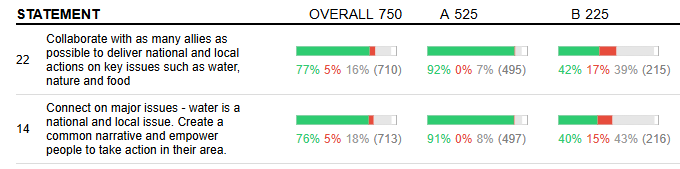
🔸 **Collaborate with as many allies as possible to deliver national and local actions on key issues such as water, nature and food.**
🔸 **Connect on major issues – water is a national and local issue. Create a common narrative and empower people to take action in their area.**
During the assembly eight **breakout rooms** discussed the question, the key themes from the discussions are summerised in this document. Additionally the groups’ three suggested actions are summerised.
### Review of our first movement assembly
##### Roses
- **Choosing the question** - strong enagement with part of the process.
- **The actual assembly** - 80 participants was a good size for an assembly and people were positively engaged.
- **The actual assembly** - the feedback survey indicated people really enjoyed the process and connecting with other rebels.
- **Polis** - DAIC (Data Analytics and Insights Circle) did an amazing amount of work for this in a short space of time. DAIC helped the Assemblies team learn more about the capabilities of this consensus-seeking tool. Future assembly converations will now achieve better results, generating deeper exploration of issues and bringing greater consensus on what matters to those who take part.
##### Buds
- **Choosing the question** - very interesting results splitting the people voting into two clear groups with quite different opinions; this offers opportunities to address tensions with greater insights and allows us to bridge our differences more easily.
- **The actual assembly** - the initial input was perhaps too long and unfocused, but at the same time was useful for the discussions.
- **The final Polis** - the two top voted suggestions (listed above) align well with XRUK's current strategy.
- **Use of Polis** - UK Assemblies team didn't fully understand the power of Polis. We gave it a go using it as a poll but this isn't its optimal usage. We are learning how we can better use it to support the movement.
- **Overall** - the UK email list was critical for getting engagement with all parts of this process, but other channels brought people too.
##### Thorns
- **Choosing the question** - there were too many statements in the first use of Polis, which made voting overwhelming.
- **Choosing the question** - using Polis in this way isn't the ideal way to use it. The question was very broad, so as not to impose agendas. However, this led to wide interpretations of what was being asked with Polis. However, it gives teams lots of useful explicit and measurable information to build on.
- **The actual assembly** - participation in the actual live assembly was lower than hoped, despite heavy promotion.
- **Sub-optimal use of Polis** - is assumed was a factor in making attendance the assembly off-putting. E.g a percentage of rebels felt the question determined did not reflect their concerns and therefore may have decided not to take part/
### Work by XRUK post-assembly
Notes will be added here of examples of circles embedding the results of this assembly in to their work.
- UK Assembly team - providing info and updates to the Rebel Toolkit, reflection and learning from feedback from this first Movement Assembly.
- Actions/Creative teams planning up-coming actions have acknowledged the level of concern over topics, such as water, food and nature.
- Although not chosen as the topic of this first Movement Assembly there was a smaller group of respondants who brought concerns over interal issues, capacity and focus of XRUK work. This has been incorporated within the work of the '[Circle Survey](https://rebeltoolkit.extinctionrebellion.uk/link/1993#bkmrk-page-title)' project.
# Post-Assembly Polis Report
#### Background
On Sunday 27 July, we had our first XRUK Movement Assembly. Around 80 participants took part and a full summary can be found here.
In breakout groups, participants were asked to generate ideas that were then added to pol.is, “a real-time system for gathering, analysing and understanding what large groups of people think. Participated by putting statements for voting on in their own words”.
The thirty-four statements developed in the break-out rooms were then opened up to the whole of the XRUK's mailing list, so 858 people responded to those statements. Participants were shown all these statements in a semi-random order and could choose to ‘Agree’, ‘Disagree’ or ‘Pass’.
Everyone saw different statements to other people, then those ideas that got the most support were displayed more often, as the algorithm in Polis weighted statements where there was more consensus.
#### Results
The full pol.is results can be found here. We recommend that everyone to take some time to explore them, but we have also summarised the findings below.
Overall, almost all the statements were found to garner consensus (Figure 1), showing that the statements submitted were fairly undivisive. For all statements, ‘Agree’ was the most common response; for only 14 of the 34 statements did we see fewer than 60% of participants choose ‘Agree’.
[](https://rebeltoolkit.extinctionrebellion.uk/uploads/images/gallery/2025-08/consesus-map.png)
**Figure 1**
Consensus statements (the majority) appear on the left; divisive statements appear on the right.*
Each statement appeared as a single dot; this showed how when people agreed with one statement, they also tended to agree with other specific ideas, ie there were groupings around some ideas.
Initially, when the version of Pol.is was still live, you could hover over each dot to view the individual statement; there is only a short window to view the interactive results, due to having to delete aspects of the data for privacy protection.
There were **only two statements that were found to be more divisive**, with the first especially divisive and the second still on the consensus side, i.e.:
1. XR should consider identifying individuals within polluting organisations who are destroying their children’s futures (in red in Figure 1).
2. Plan actions and campaigns linked to future infectious disease and avoiding harm. Climate breakdown raises the risk of pandemics.
#### Groups
Polis breaks the respondents down into groups of people who have similar opinions, but also shows where they diverge in some way from people in other groups. In this analysis, two groups were found:
**Group A (525; 61%)** - their responses can be summarised as mostly agreeing with the statements; for only four statements did fewer than 50% of Group A agree.
They were particularly supportive of ally building and local action and engaging the wider public.
**Group B (225; 26%)** - their responses can be summarised as mostly disagreeing with the statements; for no statement did 50% or more of Group B agree. They also passed with a much higher frequency than Group A.
The statements for which they showed most support tended to relate to XR policy and strategy, but were fairly mixed.
**108 people weren’t grouped (13%)** - Because of the way that pol.is was used, given limited understanding at the time, so Pol.is was treated as a simple voting tool. As a result, these people’s input unfortunately has no effect on the overall results and they have been omitted by the tool.
Despite the differences between these two groups, the top statements were the two most supported statements for Group A and the 3rd and joint 6th most supported statements for Group B. Figure 2 shows the breakdown of these two questions.
[](https://rebeltoolkit.extinctionrebellion.uk/uploads/images/gallery/2025-08/consensus-statements-1-2.png)
**Figure 2** The two most popular statements overall, with results for the whole cohort, Group A and Group B.*
These were the two statements with the most consensus, whether you just look at the overall majority, or whether you search for maximum consensus between the groups. The most popular statement related to ally building and the second refers to making national issues local; both echo decisions taken in the 2025 strategy, though these results must not be taken as representative of wider opinion.
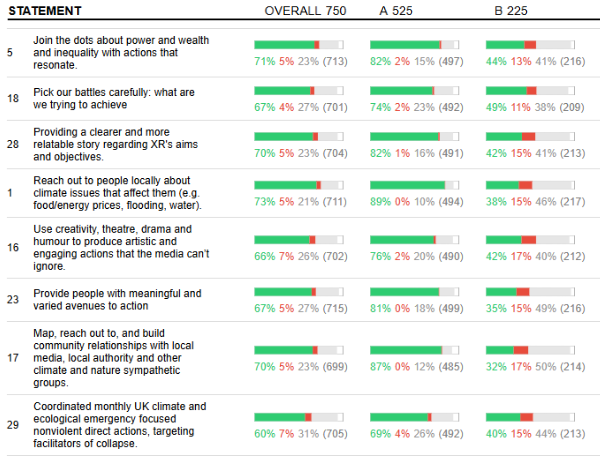
Figure 3 shows the 3rd to 10th most consensual statements, when taking into account the weighting of each of the groups (if we order solely by majority, the order of these statements changes slightly). There are a wide-range of topics covered in this group of statements but that mainly relate to XR direction and providing actions that can be regularly implemented at a local level.
[](https://rebeltoolkit.extinctionrebellion.uk/uploads/images/gallery/2025-08/consensus-statements-3-10.png)
**Figure 3** The 3rd-10th statements that drew the most consensus, when looking to draw consensus between groups.*
In terms of future assemblies or pol.is conversations to engage the wider movement in the future of XR, statements 18 and 28, (4th and 5th in the ordering), would make good topics, as they suit the conversational nature of pol.is best practice.
#### Summary
Overall, there was high consensus on most of the statements, with the vast majority of respondents agreeing with a lot of the statements. This gives a ranking of the most consensual statements, and shows that there are two groups of respondents - one of which agrees with more things and one that is much less in support of the type of statements suggested and more discerning in what they agree with. It’s also interesting to note that three groups were found in the pre-Assembly pol.is poll. This was not reflected here and there didn’t seem to be the same group who were only interested in supporting statements related to internal XR reform.
#### Considerations
It’s important to remember that not everyone on the XRUK mailing list responded to this pol.is exercise. In fact, **less than 1% of the current mailing list took part**. This cohort is likely to be a more-engaged, active percentage than the average mailing-list member. It is also important to remember that pol.is is not a straightforward preference aggregation tool. In particular, the statements will have been shown in semi-random order, influenced by previous responses, and that no statement received a response from 100% of participants, suggesting many did not get through all 34. This doesn’t mean it’s not valuable, but is something to take into account when interpreting the results.
#### What happens next?
This is just the start of the process of democratic deliberation that will take place over the coming months. There will also continue to be iteration on the use of the pol.is tool, to make the most of this interesting way of finding consensus. These consensus statements will now be passed to the Operations Circle for deliberation with a concrete proposal to use pol.is for a proper, movement-wide conversation.
#### How might we use pol.is in the future?
Pol.is is an innovative, interactive tool that allows consensus to be found between groups that apparently display division of opinion. Other projects have found that a common feature of pol.is conversations is that they demonstrate how societies or communities have more uniting them than dividing them; this is rarely acknowledged in political discourse. In 2020, the BBC made a short documentary about how the tool has been used in Taiwan, and it has also been used successfully in countries as diverse as the UK, Uruguay, Bhutan, Timor Leste, New Zealand, cities in the US and Greece, and political parties, among others.
The tool has been most successfully used in the form of an extended conversation, in which participants can rate statements, add their own, and return to rate new statements. The idea is that participants are encouraged to return to the conversation various times to vote on the new statements that have been submitted, and the aim of the ‘game’ is for participants to create statements that bring consensus within the whole cohort - both among those who already share the same opinion and others who can be brought closer to consensus. As patterns emerge of statements likely to create consensus, these will appear first when participants return to vote. For example, if a divisive statement is added, it will not receive consensus and will be ‘downvoted’ and become less visible to participants because we already know it will not achieve consensus, whereas a statement that cuts across groups will ‘rise to the top’.
Planning and delivering such an asynchronous conversation will require significant work, but the rewards in terms of identifying a unifying future direction for XR are significant.
##### References
Paice, Andy, and Martin Rausch. Creating an Online Conversation between a Nation and a Mini-Public: A Case Study on Polis & the Austrian Citizens’ Climate Council. CII, 2022. The Computational Democracy Project.
# Post-Assembly Feedback Survey
This was the first of what we hope to be many more Movement Assemblies to help us all to 'walk the talk' and learn more about each other, hear more voices and share ideas across the whole of XR.
We asked people for feedback on the assembly and have produced a summary.
#### Introduction
Following the first Assembly, a post-assembly feedback survey was launched using Qualtrix. Forty-one respondents completed the survey, of which 55% had actually taken part in the assembly.
**Reasons for not participating in the Assembly**
Of the people who hadn't taken part in the Assembly, the main reasons were:
- Other commitments
- They had joined the meeting too late and not been able to enter (5 people)
- The assembly was too late in the day
- They didn’t know about it
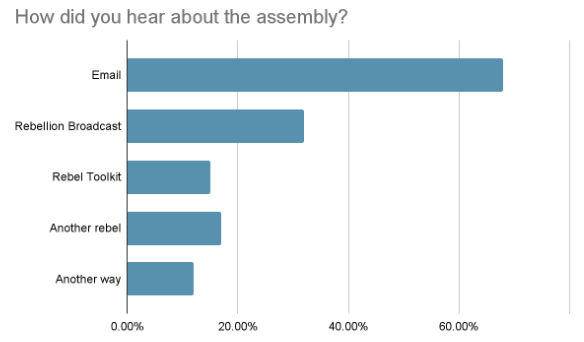
#### How did you hear about the Assembly?
[](https://rebeltoolkit.extinctionrebellion.uk/uploads/images/gallery/2025-08/feedback-1.png)
Sixty-eight percent of respondents had heard about the Assembly via the email, 32% through the Rebellion Broadcast and 15%, 17% and 12% through the Rebel Toolkit, another rebel and another way respectively (please note, rebels could select as many options as they wanted, so the total does not sum to 100%).
#### Past participation in assemblies
Only 31% of respondents said they had never taken place in an assembly before. Fifty-eight percent had taken part in a previous XR survey, 11% with Assemble, 11% in a local initiative and 3% with a different organiser. The local initiatives people stated they’d been involved with were Hay Community Assembly, York XR and Oxford Youth XR.
#### pol.is
pol.is was used to identify the question for the Assembly and also to feed back on the ideas generated. The feedback on the use of pol.is was:
**Positive comments**
- The process was easy
- There weren't too many statements (post-assembly)
**Negative comments**
- Similar statements should be grouped
- There were too many statements (pre-assembly)
- Statements weren’t actionable
- Needed to see all the statements before voting
- Statements shown first would get more votes
- Disappointment about how the first round results were fed back
#### Instructions
Respondents were asked whether they thought the instructions given at the start were clear.
**Positive (69%)**
- The process was clear
- The pre-Assembly email was useful
- The whole process was well-administered
**Negative (31%)**
- Questions being discussed should be more prominent in the breakout room
- There should be a ‘remaining character’ function on the pol.is statements
- There should have been a more prominent 15-minute warning
- Less information in the meeting/shortened intro for more time in the breakout rooms
#### Breakout rooms
Respondents were asked what they thought of the breakout rooms.
**Positive (64%)**
One comment really summarised the positive feedback.
>**It was wonderful being with experienced activists, sharing ideas and exploring options. It was great to have so much time for this, as usually sessions are far too short for in-depth conversations. Our facilitator was excellent."**
**Negative (36%)**
- Needed more time
- Conversations were too wide-ranging and off-topic
- The statements developed weren’t that useful
- One group didn’t have a note taker
- Minority views weren’t represented by the note taker
#### Suggestions for future assemblies
At the end of the survey respondents were encouraged to make suggestions for future assemblies. These are all included here:
**Assembly Format**
- Make the aim and outcomes of the assemblies clearer and more specific.
- It was too long - 2.5 hours suggested and an ‘after-party’.
- Too much focus on working out the ‘rules’.
- A second round asking the groups to make their ideas actionable/actions. Probably also give a good example before a second round.
- Maybe have two assembly sessions, one during the day and an evening one.
- Make it relevant to the law.
- Don’t have a cut-off after 5 minutes as this excludes people with computer issues.
- It seems far removed from the north - reach out to other parts of the country more.
- More diversity of people on screen.
**Speakers and Q&A**
- Cut or improve Q&A session, as questions weren't satisfactorily answered.
- Open Call for all teams to explain their role as assembly isn’t the place.
- Make the input/speakers section more relevant to the topic.
- Make the slides more interesting.
- Include relevant research.
- More speakers.
- Fewer speakers. 🙂
**Breakout Rooms**
- Longer character limit for pol.is statements.
- Set a timer on the breakout rooms.
- Have more people helping to facilitate/note taking.
- More time in breakout rooms.
#### Conclusion
Overall, people were more positive than negative about the Assembly, but there were clearly people who either didn’t enjoy the event or were not able to get into the event due to the cut-off point who were disappointed with how it went. There was a general feeling - even among positive comments - that the output of the assembly might be hard to implement, and that this could be refined in future.
The information collected in this survey will be used to iterate and improve future assemblies and pol.is polls.
>**It was a wonderful experience, so glad I did it. The longer time length to really engage with rebels I'd never met before and explore ideas was truly inspiring. Thanks to all the organisers!”**