# Participating in Actions

# Take Action Now

#### What can I do to start?

- The [Rebellion Broadcast](https://rebeltoolkit.extinctionrebellion.uk/link/985#bkmrk-%F0%9F%94%BArebellion-broadcast) provides key info on UK actions, strategy and Rebellion updates.
- The [Movement Broadcast](https://rebeltoolkit.extinctionrebellion.uk/link/985#bkmrk-%F0%9F%94%BAmovement-broadcast) provides info on UK-wide events &amp; training.
- The [Events Map](https://rebeltoolkit.extinctionrebellion.uk/books/other-online-tech-tools/page/how-to-find-events-near-you-using-the-map) is handy for finding out what is happening by location.
- The [Movement Calendar](https://rebeltoolkit.extinctionrebellion.uk/books/other-online-tech-tools/page/how-to-find-events-using-the-calendar) shows what's happening on particular dates.

#### UKwide campaigns and actions

- See the '[Current Campaigns](https://rebeltoolkit.extinctionrebellion.uk/shelves/04b-campaigns-and-action-packs)' page for ongoing, sometimes fairly long-standing campaigns and also for one-off events and actions.

#### What can I do if I have an idea for an action

Check out the separate book on [Action Planning](https://rebeltoolkit.extinctionrebellion.uk/books/action-planning).

# Actions Roles Explained

This diagram shows how the various roles involved in Actions work together and the typical journey a new volunteer would take in getting gradually more involved.

A version that allows you to zoom and pan around the diagram in more detail is [available here](https://www.figma.com/file/sdS6SvVLgYsEmcEnQb0Ixu/Actions-Pathway-(Copy)?type=whiteboard&node-id=0%3A1&t=IEZaMalk2oT7Cpra-1).

[![](https://rebeltoolkit.extinctionrebellion.uk/uploads/images/gallery/2024-03/scaled-1680-/image-1710089881271.png)](https://rebeltoolkit.extinctionrebellion.uk/uploads/images/gallery/2024-03/image-1710089881271.png)

1. Starting in the centre, we see the various ways you might be recruited.
2. You may not be able to physically attend events and so opt for **Home/Offsite** roles.
3. To start with you might simply turn up to an event and act as an **Action Attendee**.
4. You may choose to become more engaged as a **Non-Arrestable Action Participant**. Note by non-arrestable, we mean that it is not your intention to be arrested. We cannot guarantee police response to our actions, however many actions are designed so that arrests are very unlikely.
5. Once you have gained more experience, and/or been vouched for by someone known in the Actions teams, there are a group of roles that do carry a higher risk of arrest. **Arrestable Action Participant**, **Overall Action Planning**, **Action Support Planning**.
6. Alternatively you may wish to consider some of the **Street Support Roles** that turn the Action plans into reality: [**Action Support**](https://rebeltoolkit.extinctionrebellion.uk/books/action-support), [**Media &amp; Messaging**](https://rebeltoolkit.extinctionrebellion.uk/shelves/07-media-and-messaging), or [**Outreach**](https://rebeltoolkit.extinctionrebellion.uk/books/outreach/chapter/ways-to-do-outreach) roles.

As XR is radically inclusive anyone can go straight into any role except the pink ones which require prior experience and/or security verification.

# Rebel Agreement

All rebels are asked to follow our basic agreements. They provide a basis for trust so that both rebels and the public know what we can expect from each other.

#### How we take action:

- We show respect to everyone and welcome everyone.
- We commit to nonviolence, physical and verbal, and carry no weapons.
- We hold ourselves accountable for our actions.
- We bring no alcohol or illegal drugs.
- We take responsibility for ourselves and each other; we are all crew.
- We don't talk to the police unless trained to do so.
- We protect each other's identities whenever around the authorities.

Updated July 2024

# Mic Check

![Mic-Check.png](https://rebeltoolkit.extinctionrebellion.uk/uploads/images/gallery/2023-04/scaled-1680-/Mic-Check.png)

##### What is Mic Check?

It is a method to communicate with a large crowd without a PA system or megaphones.

##### How does it work?

If you hear someone shouting "MIC CHECK", also say "mic check" loudly, until everyone is quiet (or you can use the raised hand gesture to call for silence).

Then a person will ask a question or give direction. Everyone will call and respond (copy) so that a large crowd can hear. The message should be repeated until it reaches the edges of the group.

So if I said very slowly and clearly "we need to move from this site to site B, please follow the stewards" you would say in unison "we need to move from this site to site B, please follow the stewards" And the person next to you would say "we need to move from this site to site B, please follow the stewards".

It's not guaranteed stewards will always need to use mic checks, but it's a really useful tool to manage XR protest crowds 👍🏼 (and very cool when it happens as you realise it's a well oiled, connective collaborative collective - We are all crew 💚✊🏽).

##### Tips to make the technique effective

Speak in short sentences or phrases (the people around you need to hear the sentence, remember it and then repeat it).

Leave gaps between sentences so that the message can ripple out (don't speak the next sentence until you cannot hear the repeats in the crowd - this will tell you the message has spread far enough away).

If you had planned to give a speech, just go over the top key points (probably a maximum of 5 sentences).

##### Example

[Greta giving an example of the Mic Check](https://youtu.be/BTGWsgYDwck?si=QWk18_IllY24HEpj) in 2018 Declaration of Rebellion.

# Burner Phones

**When on any action with a risk of arrest, DO NOT take your regular phone**.

This is because the police can (and will) seize the phones of most people arrested, and as well as ending up with no phone, if the security on the phone is not super tight, they can copy everything from it whilst you are under arrest, putting you and other XR members at risk.

The best advice is to not take a phone with you at all, as burner phones can be expensive things to lose! If all you need is a couple of people's phone numbers, buy an old dumb phone. But if you absolutely need to take a smart phone (e.g. you are taking photos at a spicy action), make sure that it has the bare minimum of information on it. Ensure it is not connected to any of your ordinary accounts (e.g. email), and stick to the bare minimum of apps.

Burner phones should have only numbers that are completely necessary saved on them. Save any contacts that are required with pseudonyms.

If you absolutely need to take your ordinary phone to an action, ensure you know someone much less likely to be arrested who you can give your phone to if things heat up. Ensure that they can return the phone to you when you're released.

# Practical Tips for disabled protestors

#### Practical Tips for disabled protestors

Liberty has produced [this helpful guide](https://www.libertyhumanrights.org.uk/advice_information/practical-tips-for-disabled-protesters/). It includes sections on:

- Preparing to attend a protest
- What are my access needs?
- What if I'm kettled and I'm disabled?
- How to complain about the police

#### How to organise a more accessible protest

Liberty has [a guide](https://www.libertyhumanrights.org.uk/advice_information/organise-a-more-accessible-protest/) for this as well. This includes sections on:

- Include disabled people from the start
- Centre accessibility
- Information and letting people know things
- During the protest: including everyone
- Know the law

#### See also

- The [Rebel Toolkit pages on including neurodiverse and disabled rebels in actions, meetings and events](https://rebeltoolkit.extinctionrebellion.uk/books/accessibility).
- Contact XR's Disabled Rebel Network via <wellbeing+drn@exinctionrebellion.uk>.

# Nonviolent Communication


# What is NVC?

Nonviolent Communication, also called ‘Compassionate Communication’ or ‘Collaborative Communication’, has been described as a language of compassion and a tool for positive social change. It is taught as a process of interpersonal communication designed to improve compassionate connection to others. The following pages can be used as a guide to understand both what you can do to avoid situations of conflict arising and what to do should conflict arise.[![IMG_0105.jpeg](https://rebeltoolkit.extinctionrebellion.uk/uploads/images/gallery/2025-05/scaled-1680-/img-0105.jpeg)](https://rebeltoolkit.extinctionrebellion.uk/uploads/images/gallery/2025-05/img-0105.jpeg)

Marshall Rosenberg explains that “NVC is based on a fundamental principle: underlying all human actions are needs that people are seeking to meet, and understanding and acknowledging these needs can create a shared basis for connection, cooperation, and more globally – peace.” These universal human needs are never in conflict; rather, conflict arises when the strategies for meeting those needs clash.
The goal of NVC is not to get what we want, but to make a human connection that will result in everyone getting their needs met. “Understanding each other at the level of our needs creates such connection because, at this deeper human level, the similarities between us outweigh the differences, giving rise to greater compassion. When we focus on needs, without interpreting or conveying criticism, blame, or demands, our deeper creativity flourishes, and solutions arise that were previously blocked from our awareness. At this depth, conflicts and misunderstandings can be resolved with greater ease."

Learning NVC is a process similar to learning a new language or skill: step-by-step learning coupled with ample time for practice leads to growing mastery. While it takes time to develop fluency, any knowledge of a new language makes it more likely that communication can take place.

The language of NVC includes two parts: **honestly expressing ourselves** to others, and **empathically hearing others**. Both are expressed through four components, which this guide will explore: **observations, feelings, needs, and requests**.

# Expressing Feelings & Needs

<h3>Expressing Feelings</h3>

To build trusting relationships in our communities, we can start by expressing feelings. NVC instructor Daren De Witt explains the powerful impact this can have: "expressing our feelings can have a profound effect on others, enabling them to see us in a more human way. Expressing our feelings to others and reflecting back their feelings fosters empathy, understanding and trust."

[![IMG_0109.jpeg](https://rebeltoolkit.extinctionrebellion.uk/uploads/images/gallery/2025-05/scaled-1680-/img-0109.jpeg)](https://rebeltoolkit.extinctionrebellion.uk/uploads/images/gallery/2025-05/img-0109.jpeg)


**Developing a feelings vocabulary**

The more precisely we can identify and express feelings, the more effective our communication can be. It can be helpful to choose from the lists of words below and practice using them to express your feelings and help others to express theirs. You can gradually add to these lists and extend your feelings vocabulary.

**Basic feelings:<br>**
* Positive- happy, joyful, ecstatic, thrilled, delighted, elated.<br>
* Negative- sad, angry, worried, scared, embarrassed, annoyed, frustrated.<br>
* Neutral- calm, peaceful, content, neutral, curious, observant. 


Generally speaking, our culture places considerably less value on the expression of feelings than on the expression of ideas. Consequently, there is often confusion around the accurate expression of our feelings. Some of the commonest mistakes are: 

A thought masquerading as a feeling: e.g. ‘I feel that you aren’t listening to me’. To clarify feelings in these instances, ask 'How would I feel if I weren’t being listened to?’ You may feel frustrated, sad or upset. 

Confusing feelings with how we think others are behaving towards us:  E.g. ‘I feel manipulated by him’. This is an interpretation of behaviour. How might I feel if I interpreted his behaviour this way? Annoyed or confused, perhaps. 

Confusing feelings with evaluations of ourselves: E.g. ‘I feel useless at this task’. ‘Useless’ is an evaluation or judgement. How might we feel if we thought we were useless? Dejected or disappointed, perhaps. 

Confusing feelings with needs: E.g. ‘I feel understood’. If my need for understanding had been met, I might feel relieved, grateful or satisfied.

Expressing our feelings as if they were caused by others: E.g. ‘I feel irritated by you’. Others may be the stimulus or trigger for our feelings, but they are never the cause. The cause is our unmet need. E.g. ‘I feel irritated because I am needing some peace and quiet.’ Confusion and conflict can be avoided if we own our feelings rather than blaming others for them, or thinking they are responsible for them. <p>

<h3>Expressing Needs</h3>

“When we’re in conflict with others, we often feel angry, and we criticise and blame them and ourselves. This often results in others feeling angry too. As a result, we are less likely to get what we want. A more effective approach is to pause, take a deep breath and work out what our need is, and then communicate it. The other person will better understand where we are coming from, and we are more likely to get our need met or have a constructive discussion about it.” 

Feelings are clues as to what our needs or others’ needs might be. For example, a person might feel irritated and distressed if their need for respect is not being met. Pleasant feelings are clear signals that our needs are being met; painful feelings indicate unmet needs. Being able to recognise feelings will help us to uncover needs. 

**Some Needs We All Share:**<br>
* Play- engagement, fun, freshness, spontaneity, stimulation, rhythm, variety, comfort, ease, relaxation.
* Meaning- purpose, contribution, awareness, beauty, mystery, wholeness, adventure, challenge, creativity, growth, learning, achievement, completion.
* Love- care, nurture, affection, closeness, intimacy, touch, sexual expression.
* Community- belonging, connection, friendship, contact, inclusion, participation, solidarity, loyalty, help, support.
* Subsistence- food, water, light, air, space, warmth, movement, rest, health, hygiene.
* Clarity- knowledge, awareness, to understand, reassurance, simplicity, order, accuracy, competence, efficiency, skill.
* Autonomy- independence, freedom, choice, control, power, authenticity, integrity.
* Protection- containment, safety, security, peace.
* Empathy- understanding, sympathy, acceptanc, acknowledgement, recognition, to be valued, consideration, respect, trust, celebration, mourning.
* Equity- equality, fairness, sharing, cooperation, collaboration, honesty, openness, keep to agreements, reliability, consistency, justice, tolerance, balance, harmony, unity.


**Different Ways of Saying Needs:**<br>
I need…<br>
I would like…<br>
I value…<br>
I want…<br>
I love…<br>
It’s important for me to have…<br>
I would be really grateful to have some…<br>
I really enjoy…<br>
I long for…<br>
I’m hoping for some…<br>
I could really do with some…<br> 
...is fun for me<br>
...matters to me<br>
Some...would mean/do a lot for me<br>
Some...would be really helpful to me<br>
Do you need…?<br>
Would you like some…?<br>
Do you value…?<br>
Does...matter to you?<br>
I’m wondering if you might be wanting some…?<br>
Is it important for you to have…?<br>
Would you be grateful for some…?<br>
I’m guessing that you’re longing for…?<br>
Are you hoping for some…?<br>
Is this all about...for you?<br>
Is this issue to do with...for you?<br>
Would some...make a big difference for you right now?<br>

# Importance of Listening

Along with expressing your own feelings and needs clearly, its important to really listen to and identify the same in others. 

<h4>Reflective Listening </h4>

Reflective listening shows you understand what another person is saying and meaning. It especially involves paraphrasing in your own words and using their ‘key words’ when they carry emotional charge. This kind of empathic listening can also have a profoundly clarifying effect. As psychologist Carl Rogers put it: ‘When I have been listened to and when I have been heard, I am able to re-perceive my world in a new way and to go on. It is astonishing how elements that seem insoluble become soluble when someone listens, how confusions that seem irremediable turn into relatively clear flowing streams when one is heard.’

Philosopher Eugene Gendlin describes the steps involved in reflective listening:

“To show that you understand exactly, make a sentence or two that gets at the personal meaning this person wanted to put across. This will usually be in your own words, but use that person's own words for the touchy main things.”
“People need to hear you speak. They need to hear that you got each step. Make a sentence or two for every main point they make.”
“Sometimes what people say is complicated. You can't get what they say, nor what it means to them, all at once. First make a sentence or two about the crux of what they said. Check that out with them. Let them correct it or add to it if they want to. Take in, and say back, what they have changed or added, until they have agreed that you have it just as they feel it. Then make another sentence.”

<h4> Empathic Listening</h4>

A key ingredient of empathy is presence; this distinguishes empathy from mental or intellectual understanding or sympathy. "When we are thinking about people’s words and listening to how they connect to our theories, we are looking at people - we are not with them".  Empathic listening is being “fully present to what the other person is feeling and needing, and not losing that through a fog of diagnosis and interpretation”. The listener needs to focus their awareness - and keep it focused - on the other person. This requires a degree of inner stillness in the listener, so that their focus does not switch to themselves whilst they are empathising. This is a matter of being so focused on the feelings of the speaker that our own reactions, preconceived judgements, analysis or interpretations do not intrude. 

Rosenberg describes the following analogy to explain the nature of the focus that empathy requires: "Recall a time when you had a pain in your body, perhaps a headache or a toothache, and you became totally engrossed in a book. What happened to the pain? You no longer felt it. You didn’t suppress it; rather the focus of your attention was so fully on what you were reading that you were not aware of the pain. In empathy our attention is so fully focused on the feelings and needs of the other person at that moment that we are not aware of our thoughts about the person."

"The presence that empathy requires is not easy to maintain... Instead of offering empathy, we tend instead to give advice or reassurance and to explain our own position or feeling, [or believe we have to ‘fix’ situations and make others feel better]. Empathy, on the other hand, requires us to focus full attention on the other person's message. We give to others the time and space they need to express themselves fully and to feel understood. There is a Buddhist saying that aptly describes this ability: 'don't just do something, stand there'.”

**There are some common behaviours that prevent us from being sufficiently present to connect  empathically with others. The following are examples:**

Advising: “I think you should … ” “How come you didn’t … ?” <br>
One-upping: “That’s nothing; wait’ll you hear what happened to me.” <br>
Educating: “This could turn into a very positive experience for you if you just … ”<br>
Consoling: “It wasn’t your fault; you did the best you could.” <br>
Storytelling: “That reminds me of the time … ” <br>
Shutting down: “Cheer up. Don’t feel so bad.” <br>
Sympathising: “Oh, you poor thing … ” <br>
Interrogating: “When did this begin?” <br>
Explaining: “I would have called but … ” <br>
Correcting: “That’s not how it happened.” <br>

While we may choose at times to sympathise with others by feeling their feelings, it’s helpful to be aware that during the moment we are offering sympathy, we are not empathising.

[![IMG_0107.jpeg](https://rebeltoolkit.extinctionrebellion.uk/uploads/images/gallery/2025-05/scaled-1680-/img-0107.jpeg)](https://rebeltoolkit.extinctionrebellion.uk/uploads/images/gallery/2025-05/img-0107.jpeg)


<h4>Deep Empathic Listening for Feelings and Needs</h4>

In situations of conflict, people can react with intensity, and their words do not reflect their feelings and needs. You can use the components of NVC to tune in to the feelings and needs of others, "in contrast to either (1) blaming yourself by taking the message personally, or 2) blaming and judging them." Rosenberg describes how empathic listening can help us to uncover what is truly alive in another person: 

“In NVC, no matter what words others may use to express themselves, we simply listen for their observations, feelings, needs and requests...If I'm using NVC, I never, never, never hear what someone thinks about me. Never hear what someone thinks about you, you'll live longer. You'll enjoy life more. Hear the truth. The truth is that when somebody's telling you what's wrong with you, the truth is they have a need. Isn't getting met. Hear that they are in pain. Don't hear the analysis.”

Here is an example of Rosenberg putting empathic listening into practice to uncover the needs underneath what people say: 

“I was working in a refugee camp in a country not very pleased with the United States. There were about 170 people assembled, and when my interpreter announced that I was an American citizen, one of them jumped up and screamed at me, “Murderer”! 
Another one jumped up and shouted: “Child killer!”
Another: “Assassin!”
I was glad I knew NVC that day. It enabled me to see the beauty behind their messages, to see what was alive in them. 

We do that in NVC by hearing feelings and needs behind any message. So I said to the first gentleman, “Are you feeling angry because your need for support isn't getting met by my country?”
Now, that required me to try to sense what he was feeling and needing. I could have been wrong. But even if we are wrong, when a person trusts that we’re sincerely… trying to connect with their feelings and needs in that moment, that shows the other person that no matter how they communicate with us, we care about what's alive in them. When a person trusts that, we're well on our way to making a connection in which everybody's needs can get met. 

It didn't happen right away because this man was in a lot of pain. And it happened that I guessed right, because he said: “You're #!@&%! right!” adding: “We don't have sewage systems. We don't have housing. Why are you sending your weapons?” 

I said: “So, sir, if I'm hearing you again, you're saying that it's very painful when you need things like sewage systems and housing - and when weapons are sent instead, it's very painful.”

He said “You're #!@&%! right! Do you know what it's like to live under these conditions for 28 years?”

“So, sir, you're saying that it's very painful, and you need some understanding for the conditions that you're living under.” So I heard what was alive in the guy, not that he thought I was a murderer. When he trusted that I sincerely cared about what he was feeling and needing, he could start to hear me.

Then I said, “Look, I'm frustrated right now because I came a long way to be here. I want to offer something and I'm worried now that because you've got me labeled as an American, you aren’t going to listen to me.” 

He said, “What do you want to say to us?” So he could hear me then. But I had to see behind the human being behind the names he was calling me.”

**Once we have heard the feelings and needs of the person we are communicating with, they are much more able to listen to what we have to say.**

# Neutral Observation

<h3>Observing Without Evaluating</h3>

The NVC process typically begins with neutral observation. "Observations are what we see or hear that we identify as the stimulus to our reactions. Our aim is to describe what we are reacting to concretely, specifically and neutrally, much as a video camera might capture the moment. This helps create a shared reality with the other person. The observation gives the context for our expression of feelings and needs, and may not even be needed if both people are clear about the context. 

The key to making an observation is to separate our own judgments, evaluations or interpretations from our description of what happened. For example, if we say: 'You’re rude', the other person may disagree, while if we say: 'When I saw you walk in and I didn’t hear you say hello to me', the other person is more likely to recognise the moment that is described." Evaluations can be received as a judgement or attack, and can provoke a reaction, resistance and counter-attack from the other person.  

NVC trainer Dian Killian suggests we can mostly easily make neutral observations "in conversations... by recapping what someone has said, without emotional input. That means not attaching any 'story' to your response... Comments that begin in the first person, i.e. 'I hear you say…' work better than 'You just said…'" For example: 

Person 1: “We have to do something about the illegal immigrant problem, because they’re taking away our jobs, and people like you don’t care.”

Person 2: ”I’m hearing you say that you’re worried about your job security and that other people in this country are ignoring that concern.”

Re-capping what we have heard slows the pace of conversation, and forces both sides to reflect and clarify. It does require practice, as Killian point outs: “It’s a muscle to develop, because what we usually do when we’re disturbed by something is start disagreeing right away.” 

It can also be instinctive to respond with judgements and diagnosis. Rosenberg gave an example of some teachers he worked with who were having a conflict with their administrator. He asked them: “What does he do that you don’t like?” They initially responded by saying: “he has a big mouth”, “he talks too much”, and “he thinks he’s the only one with any intelligence.” After some prompting, they described specific behaviours that did not meet their need for efficiency, for instance during staff meetings, regardless of the agenda, the administrator would relate it to one of his war experiences or childhood experiences. As a result, their meetings lasted much longer than scheduled. This is a clear observation without any evaluations mixed in. Here are some more examples:

|   Evaluation    |   Observation     |
|-----|-----|
| “You are so rude!” | “When you tell me to get lost…” |<br>
|“You’re selfish!”|“I asked if someone could help me and you carried on with the task you were doing.”|<br>
|“This place is a pigsty!”|“There are clothes and toys covering most of the floor.”|<br>
|“When I hear you yelling at Dad…”|“When I hear you and Dad talk like that…”|<br>


Making clear, non-judgemental observations can:
* clarify what you are reacting to (what triggered you)  
* establish common ground
* separate your interpretations from what actually happened 
* be part of taking responsibility for your actions.

# Making Requests of Others

The fourth component of NVC involves making a request to others. We are asking them to do something to satisfy a need of ours. Our requests are strategies through which we might get our needs met. Needs are universal. The strategy through which we are asking to get our needs met is specific - we are asking to get our need met by a specific person, in a specific way, often at a specific time. 

In ordinary communication **we often confuse the level of ‘needs’ with the level of ‘requests’.** We don’t mention our need but ask for the strategy as if it were a need, e.g. ‘I need you to turn off your radio’ (our actual need here is for peace and quiet). Confusing the need with the request can contribute to conflict. Separating our need from the request helps us to be determined about getting our need met, and flexible about the way in which that need is met. This in turn gives the person we are in conflict with the opportunity to be flexible - to meet our needs in a way that will also meet any needs they have. 

**A useful and clarifying rule to return to is: hold tight to the needs, and loose to the strategies.** For example, imagine you are in a room with another person who is feeling too hot, but you are feeling cold. The other person wants to open the window to let in a cool breeze, but opening the window is a strategy that does not meet both your needs. Instead, you could put on a jumper, and the other person could put on some lighter clothes. By flexibly exploring other strategies with a focus on needs, everyone’s needs can get met. 

**Our requests are more likely to be met with a ‘yes’ if they:**
* are specific - specifying exactly what you want, and when, with who, and where, makes your request easier to act on. 
* offer choice - people enjoy the respect involved in being asked. The phrase ‘would you be willing to…?’ captures the spirit. 
* are positive - are in the form of a ‘do’ rather than a ‘don’t’.
* are doable - in manageable, bite-sized chunks.
* take the other person into account - getting a sense of what is going on for them is important for making requests that meet our needs as well as theirs. 

**There are three types of request we can make of others:**
1. Request to connect empathically: “How do you feel when you hear what I just said?”
2. Request for another person to connect with you: “Would you be willing to tell me what you understand me to have said (so I can check I've made myself clear)?"
3. Action request (for them to actually do something): “So, would you be willing to…(e.g. Take your shoes off when you come into the house)?”

# What to do Should Conflict Arise?

Should conflict arise, connecting with peoples’ feelings and empathically reflecting back to them what they are saying is an effective starting point. Studies done in labour management negotiations indicate that the time needed to settle disputes can be considerably shortened if one simple rule is followed: each participant must paraphrase what the previous speaker has said before saying anything in rebuttal.

Once you have heard the feelings and needs of those involved in the conflict, you can use the steps below to communicate your needs and explore strategies to meet them, as well as the needs of others. 

[![IMG_0112.jpeg](https://rebeltoolkit.extinctionrebellion.uk/uploads/images/gallery/2025-05/scaled-1680-/img-0112.jpeg)](https://rebeltoolkit.extinctionrebellion.uk/uploads/images/gallery/2025-05/img-0112.jpeg)


1. **Express Yourself Using the Four Ingredients of NVC:**

<ul>Observation: “When I see / hear…”

Feeling: “I feel…”

Need: “Because I need / would like…”

Request: “Would you be willing to…”</ul>

2. **Hear their response and connect empathically with them. Try:** 

<ul>Reflective Listening - mirror back what you are hearing them say. 

Connecting with the needs underneath what they are saying, “Are you needing…?”

Connecting with their feelings, if their feelings seem strong, “I’m sensing you’re feeling…?”

(N. B. You may need to do any of these things two or three times until you have connected fully to their needs and they sense that they have been heard.) </ul>


3. **Put all their needs and your needs on the table:**

<ul>“I want you to get your needs met for…

...AND…

I also have a need for… (your original need(s) that you expressed with the four ingredients in part ‘2’ above).”</ul>


4. **Look for solutions / strategies:**

<ul>“Do you have any suggestions for how we could resolve this so you get … (your need)... and I can get… (my need)?<br>
OR<br>
“How about if we…?”</ul>

# Activities

[![IMG_0111.jpeg](https://rebeltoolkit.extinctionrebellion.uk/uploads/images/gallery/2025-05/scaled-1680-/img-0111.jpeg)](https://rebeltoolkit.extinctionrebellion.uk/uploads/images/gallery/2025-05/img-0111.jpeg)

Below are a few activities to try out to practise the methods of NVC. The following page also has suggestions on reviewing the activities.

**Activity 1: Identifying Feelings**

In each of the following statements, do you regard the speaker to be expressing his or her feelings? If not, please edit the sentence until it does. 

‘I feel dismissed when no one at work responds to my suggestions’. 

‘It feels completely incomprehensible how you can do such a thing.’

‘I’d be furious too if that had happened to me.’

‘You’re wearing me out.’

‘I feel independent, now that I have my own car and paycheck.’

‘I feel I am being unkind to others.’

‘I feel you’re annoying me on purpose.’

---

**Activity 2: What is my need here?**

Consider the question, ‘What might my need be if I had the following thought in my head during a meeting?’ Have a go at translating each statement into a possible feeling and need. 

“She’s irresponsible. We all agreed to let someone know if we weren’t going to show up.”

“Everyone else here knows more NVC than I do.”

“He always takes more time than everyone else.”

“People needing therapy ought to get professional help. We can’t handle that level of dysfunctionality here!”

“This is boring.”

“There should be a rule against using offensive sexist language in a group like this.”

“There he goes again...someone should just shut him up!”

“This group of people is so cold and rigid.”

---


**Activity 3: Exploring Feelings and Needs**

Take a blank side of paper and at the top, write down something somebody said to you that you didn't like hearing.

Write down how you're feeling when you think about what they said. 

Write down what you were needing and not getting the moment you heard the words. 

Then, write down what you imagine the other person was feeling when you heard what they said. 

After identifying their feelings, write down what you imagine the other person was needing and not getting in the moment you heard their words.
Check in with yourself and see if you notice a shift in how you feel about what was said to you or how you feel toward the person that said it.

Finally, explore what actions you might both take in order to better meet the needs you identified.

---

**Activity 4: Empathy Exercises**

You can use the following scenarios to practice empathic listening and expressing empathy.

A) Someone at work says to you: “I couldn't sleep until 3 a.m. last night, thinking about our presentation today. So this morning I figured I'd better drink lots of coffee to keep me awake and alert… but now my head is killing me!  Why do I always get hit with headaches when something important needs to be done?!”

Give a reply that demonstrates intellectual understanding of the situation by addressing the speaker’s question (last sentence.)
Give a reply that demonstrates sympathy rather than empathy. 
Give a reply that offers advice.
Give a reply verbalising empathy.

B) At a meeting, while you are in the middle of a sentence, someone turns to you suddenly and says, ‘don't you ever let someone else have a chance to talk?’ Respond to this person with empathy by: 

Sensing and reflecting back what the person might be observing. 
Sensing and reflecting back what the person might be feeling and needing. 
Sensing and reflecting back what the person might be requesting. 

C) Recall an experience you had of ‘listening to someone with your whole being.’

D) What are some conditions either internal (inside yourself) or external that support your ability to be empathic? What are conditions that work against it?

---

**Activity 5: Observation or Evaluation?**

Please note - these are not examples of NVC, but only of the observation component.

“They have clear-cut over 90% of this territory, and are still continuing.”

“All the people in my practice group say that one of the best ways to learn NVC is simply to practice, practice, practice.”

“I heard you say you passed all your courses but this report card shows two F’s.”

“This is the fourth time I'm this week that you stated you disagree with something I'm saying.”

If both parties (e.g. parent and teenager in a family) are in clear agreement regarding what constitutes ‘first getting permission’ then I would consider the speaking to be making an observation free of evaluation.

---

**Activity 6: Making Requests - Incorporating All Four Components Into NVC**

“When I see your dog leaving turds on the lawn, I feel upset. We have kids who play here and I want the yard to be a safe, clean space for them. Would you be willing to use this plastic bag to remove the turds?

“When I hear you addressing me like that, I feel agitated because I need cooperation and a peaceful resolution of our differences. Are you willing to tell me what you are feeling and needing right now instead of what you think I am?”

“When I hear you have put your money in mutual funds, I feel dejected because I'd like to see us put our resources into what we value, rather than to support guns, tobacco and sweatshops. Would you be willing to tell me what you were feeling when you hear me say this?”

“I am worried about the calories in this soup because I really need to take care of my health. Would you be willing to give me a bowl of noodles instead?”

“When I read this report you wrote, I feel troubled, because I value teamwork and I need some reassurance that we are on the same page. Would you be willing to make an appointment so we can discuss how we each see the priorities for this job?”

---

**Activity 7: Observation or Evaluation?**

For the following statements, do you regard the speaker to be making an observation free of evaluation? If not, please give an example of an evaluation-free statement that matches the situation.

“They are destroying the environment.”

“One of the best ways to learn NVC is simply to practice, practice, practice.”

“You lied to me about your grades.”

“You are arguing with me for the fourth time this week.”

“You drove the car without first getting my permission.”

Please see the end of the guide for sample responses.

---

**Activity 8: Making Requests - Incorporating All Four Components Into NVC**

Imagine situations where someone utters the following statements. In each case, translate the statement using all four components of NVC, paying special attention that the request is positive, concrete, and immediately doable. 

“Your dog just made a mess on my lawn.” (Translate to: “When I see your dog…[observation] I feel... [feeling], because I need [need], and would you be willing to…[request]?”)

“Yelling obscenities isn't going to get you what you want.”
“By putting your money in mutual funds, you're just supporting guns and tobacco and sweatshops and all the things we’re trying to change in this world.”

“This soup is much too calorific.”

“At this company, we require teamwork. If that's not a priority for you, you'd better be looking for another job.”

“But you told me two weeks ago that it would be fine if I were to take a long weekend this month.”

---

**Suggested practice: NVC Journaling**

To support your NVC learning and practice, you can journal the incidents that happen each day. 

Write down what happened (practising using observational language). 

Then write down your judgments of the other person and yourself. 

Translate your judgements into feelings and needs as you do this. 

Then write down what the other person’s feelings and needs might be. 

Finally, consider what actions you could take to meet the needs you identified.

# Reviewing the Activities

**Activity 1: Identifying Feelings**

Please note - these are not examples of NVC, but only of the feeling component.

‘I feel anxious when no one at work responds to my suggestions.’

‘I feel very puzzled about how you can do such a thing.’

‘I feel concerned that this happened to you. I would have been furious if it had been me.’

‘I feel exhausted.’

‘I feel pleased and proud to have my own car and paycheck.’

‘I feel regret in how I am behaving toward them.’

‘I feel upset because I think you are annoying me on purpose.’

---

**Activity 2: What is my need here?**

Example translation into an observation, feeling and need: ‘When I hear that none of us got a call from her, I feel discouraged because I want to be able to count on us carrying through with agreements we make together.” 

Universal needs: reliability, trust, integrity

Universal needs: competence, acceptance, respect

Universal needs: mutuality, consideration, efficiency

Universal needs: safety, integrity, competence

Universal needs: stimulation, purpose, challenge

Universal needs: respect, community, support

Universal needs: consideration, connection, stimulation 

Universal needs: inclusion, warmth, community 

---

**Activity 4: Empathy Exercises**

Suggested responses to scenario A:

“It's probably because you have a lot of tension when you are anticipating something important. Or maybe it's a combination of stress, lack of sleep, and the caffeine that's causing your headache.”

“I really feel for you. it's the worst thing to have a horrible headache when you are about to do an important presentation!”

“Why don't you take this ice pack and lie down for about 10 minutes?”

“Are you frustrated because he would really like to be feeling energetic, healthy, and clear-headed for this presentation?” 

Suggested responses to scenario B:

“Are you referring to my going ‘Oh no, oh no, oh no’ when Peter pointed to the map?”

“Are you feeling irritated because you want everyone to be heard?” 

“Would you like for us to go around and hear from everyone before I speak again?”

# Post Action Blues

#### A Guide To Coming Down to Earth

[![fire.jpeg](https://rebeltoolkit.extinctionrebellion.uk/uploads/images/gallery/2024-07/scaled-1680-/fire.jpeg)](https://rebeltoolkit.extinctionrebellion.uk/uploads/images/gallery/2024-07/fire.jpeg)

The last few years have been both a productive and challenging time for Extinction Rebellion. The movement has had to learn on its feet and adapt to a continuously changing landscape whilst experiencing new tactics from the police, and new laws from Parliament. Many conversations have been brought to light in the critiques of XR and we have seen some of the flaws within our own processes and systems.

However, we **have** changed the conversation. Through the action we take as a movement we continue to turn the focus upon the climate and ecological emergency. Through our creativity, adaptability and resilience we are all engaged in the mission of raising the alarm and remembering what it truly means to be humans as part of nature – that we are a part of the Earth.

We acknowledge that many communities are already living on the front lines of the climate and ecological emergency. These communities are already living a regenerative and resilient response in the face of the challenges, as the waters and temperatures rise. There is much to be learned from these communities and the cultures that are living on the front lines of the climate and ecological emergency.

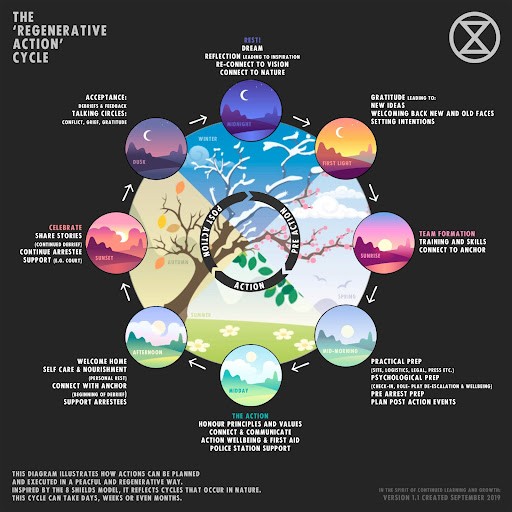
A regenerative culture and regenerative action cycles are what can support this movement to sustain its work and to develop resilience in the face of the emergency. Reflection &amp; learning are all part of the process of regenerative care and it feels as though there is much work to be done.

#### Practical Next Steps

On the frontline of activism we are confronted with many feelings. The impacts of the events, both positive and negative, can have long-lasting and wide reaching effects on the individuals involved. The action doesn’t end when you leave the site and go home; there could be social implications with court cases, family or workplace issues. Simultaneously, the emotional journey can unfold in subtle ways. People may feel isolated, alienated or estranged, filled with self doubt or even shame. The extent of the impact may not be apparent in the immediate aftermath of the action, and often can build over time if it is ignored.

Long-term involvement in emotionally demanding situations is easier to cope with when you have a way of being with and processing the emotional states that the situations evoke. Taking time to rest, reflect and recover after big actions is essential to processing these feelings and avoiding burnout, especially with the potential for more sustained and frequent attrition actions. Buddies, anchors, support from your Local Group, talking circles, and other ways we can resource ourselves. Exercise, time-out, nature, mediation, yoga, spending time with loved ones, can all support. Self-care is not selfish. Only by taking the time to refresh and renew ourselves as individuals can we collectively bring our best to future actions and ongoing commitments.

#### The Cycle of Regeneration

There is much to be learned from the cycles of nature and the patterns of the days and years. The Regenerative Action Cycle has been created from observations of these natural cycles and developed through indigenous wisdom and regenerative cultures. It is a way for us to plan, act, process and reflect in ways that are connected to a rhythm and cycle, bigger than ourselves.

<div align="center" id="bkmrk--1">![](https://rebeltoolkit.extinctionrebellion.uk/uploads/images/gallery/2022-08/scaled-1680-/Regen-Action-Cycle.jpg)</div>The Regenerative Action Cycle invites us to:

<table id="bkmrk-time%2Fseason-action-a"><thead><tr><th>Time/Season</th><th>Action</th></tr></thead><tbody><tr><td>Afternoon/Late Summer</td><td>Take care of ourselves and connect with our anchors as we return home</td></tr><tr><td>Sunset/Autumn</td><td>Celebrate and share stories in small gatherings</td></tr><tr><td>Dusk/End of Autumn</td><td>Accept, debrief, feedback and honour the emotions raised by our actions</td></tr><tr><td>Midnight/Mid Winter Rest</td><td>Reflect and dream new visions</td></tr><tr><td>First Light/ Beginning of Spring</td><td>With gratitude, come together again to develop new ideas and set new intentions</td></tr></tbody></table>

This then leads into the next steps for future actions:

<table id="bkmrk-time%2Fseason-action-s"><thead><tr><th>Time/Season</th><th>Action</th></tr></thead><tbody><tr><td>Sunrise/Mid Spring</td><td>Creating teams, training for actions</td></tr><tr><td>Mid Morning/Beginning of Summer</td><td>Practical Preparation, Pre Arrest prep etc</td></tr><tr><td>Midday/Height of Summer</td><td>The Action</td></tr></tbody></table>

#### Expanding Circles of Support

We are cultivating a culture in which we are invited to explore and empower our inner and collective resourcefulness. We can learn to draw on our own wisdom and learnings to be able to support ourselves and each other. We can do this through creating experiences of connection and safe spaces in which we are able to express ourselves and be heard and held.

**The expanding circles of support are:**

1. You – connect to yourself and your needs.
2. Your buddy – find someone who you can share support with.
3. Your local/affinity/working group – connect as a community.
4. Local trained support – resourcing ourselves through trained support and input.
5. XR Regenerative Culture – resources and services to support local regenerative culture advocates and individual activists.

#### Debrief! Debrief! Debrief!

Check-ins and debriefs are crucial, yet often omitted in the rush of an action or its aftermath. It can be beneficial to take a moment to ground yourselves, come together as a group and create a connected and caring atmosphere and enquire:

- How am I right now?
- What do I need?
- How are we as a group?
- How can I support the health of this group?

We advise:

Check ins during or immediately after an action → [AG Check-in](https://docs.google.com/document/d/1KFq1dMvG4135m7t8NSQHczdexEq4nbMA-IgB3pAeDeA/edit)

Debrief 1-3 days after an action → [Offsite Debrief](https://rebeltoolkit.extinctionrebellion.uk/link/28#bkmrk-page-title)

Ongoing talking circles/reflective spaces → [Talking Circles](https://docs.google.com/document/d/18hpXURhMm5ElEWVQcl4LYZ1ZCsz0k5uCDAIaNSNi1aM/edit)

#### Connection, Gratitude and Celebration

Connection is one of the foundations of a Regenerative Culture. We live in an interdependent web of life; connecting with this web of life is the most natural, yet often most forgotten, aspect of what it is to ‘be’. It is essential for us to realise our potential as a species, characterised by our capacity to experience and express kindness, compassion and love in abundance.

Being grateful roots anything we do in an awareness of interconnectedness to all the causes and efforts that preceded us. Gratitude is a humbling process that helps us both diminish the limitations of our limited self and understand ourselves as a part of something bigger. Some people keep diaries or photo journals, or just a few moments of silent or vocal reflection at the start and end of every day.

Come together to celebrate in whatever way your community enjoys. Don’t forget to thank those who have supported you; your families and loved ones, partner groups friends and communities, for the support they have given. National celebrations and debrief will be arranged between national actions to gather lessons learned and feed into future actions.

#### Emotional Support

[Trained Emotional Support Network (TESN)](https://rebeltoolkit.extinctionrebellion.uk/link/1431#bkmrk-page-title) is a collective of professionals with experience in supporting people through emotional and psychological processes.

#### Grief Tending

Through grief we can expand our capacity to love. Many who love this earth and this life are experiencing grief in some form now. Coming together to grieve can help both our connection to each other, nature and help us stay resilient in the coming days.

**Grief tending resources:**  
The Wild Edge of Sorrow (Francis Weller)  
The Smell of Rain on Dust (Martin Prechtel)  
The Healing Wisdom of Africa (Malidoma Somé)

#### Nature Connection

This can also be a good time to go and be in nature to recharge and restore yourself – sit under a tree, wander timelessly in the woods, stop and listen to the birds, nourish yourself with the beauty of the other than human world. Your practice can be deepened by dropping in to your senses and your breath, to take your body and your felt connection with the wild world for a walk. When you notice yourself drifting amongst your thoughts and with less connection to your environment, then you can return to feeling your connection with the earth, gravity pulling you in to it, and your breath.

#### Arrestee Support

Some rebels engaging in XR’s non-violent direct actions are willing to face arrest. We have a personal, and collective responsibility to support our rebels and need to foster a sustainable and regenerative approach to the consequences of nonviolent direct action. This process begins with adequate pre-action preparation and continues through to reliable post-arrest care. In doing so we are both extending care and compassion to each other, and ensuring the sustainability of our movement.

Please have a look at the Arrest Welfare web-page below for more information about the arrest cycle and the resources and training we have available to support our rebels through this process. Below we include a summary of some of the specific areas of support available.

[Arrestee Welfare Webpage](https://extinctionrebellion.uk/act-now/resources/arrestee-welfare/)

[Arrestee and Legal Support Rebel Toolkit pages](https://rebeltoolkit.extinctionrebellion.uk/books/arrestee-and-legal-support)

**Post Arrest Liaison (or PAL Support)** can provide signposting to the above resources and also offers a sympathetic ear through telephone contact. Please email us at **xr-arrestwelfare@protonmail.com** if you’d like to arrange a PAL, placing ‘PAL Request’ in the subject heading.

We are also able to support you in making a self-referral to a trained talking therapist through the **Trained Emotional Support Network**. Just email us at **XR-ArrestWelfare@protonmail.com** and we can forward you the referral template.

The Arrest Welfare team also have a team of volunteers who provide **Court Support and Accommodation** for court appearances. Please email <xr-arrestwelfare@protonmail.com> if you would like to connect with these networks.

For **Legal-related questions** please check out [informeddissent.info](https://informeddissent.info/) web-page and the for [XR legal support web-page](https://rebellion.earth/act-now/resources/legal-info/).

If you do not find your answer on these pages then please email the XR legal team at <xr-legal@riseup.net>.

# Travel Bursary Scheme

UPDATE Aug 2025 - Unfortunately the travel bursary scheme is not currently available.