# Self Care
# Self care - Introduction
> In many shamanic societies, if you came to a medicine person
complaining of being disheartened, dispirited or depressed,
They would ask four questions:
When did you stop dancing?
When did you stop singing?
When did you stop being enchanted by stories?
When did you stop being comforted by
The sweet territory of silence?
>
> — Gabrielle Roth
As a vital part of the XR Movement ecosystem it is important that we look after ourselves and our needs. As part of a Non Violent Action movement we may choose to take certain risks and be prepared to endure discomfort sometimes, even imprisonment, but love and care rather than self-sacrifice is a wiser goal of our activism.
If we do not hold a balance between the individual and the group in mind, we may end up exhausted, or burnt-out or resentful and no longer a fully functioning part of the network of relationships that make up the movement.
When we feel furious, fearful or heart broken about the damage being wreaked on our planet and about the harm and potential harm on loved ones human and non-human; our nervous systems’ can drive us to a wish to take the most extreme action in response. This is part of the flight or fight response, it is a very natural reaction to our emotional state and to a sense of urgency. Of course urgency is part of the picture, but if we make a decision solely from this view point we narrow our perspective and will not have access to the full picture of our experience or the consequences of our actions.
It can be helpful to be aware of our motivations to take on roles or take actions. Often our histories can leave us with characteristic habits of pleasing or serving others, being the best, fitting in, rebelling against authority etc. These stories we hold about ourselves and our place in the world may have helped us thrive in challenging circumstances and can still be very motivating. However, they can lead us to behave in ways that fit an old story of our life rather than being the wisest approach to the present situation.
It is vital that we adopt practices and behaviours that support both our wellbeing and energetic engagement and our self-awareness.
[](https://rebeltoolkit.extinctionrebellion.uk/uploads/images/gallery/2025-05/img-0120.jpeg)
> Peace-making doesn’t mean passivity. It is the activity of interrupting injustice without mirroring injustice, the art of disarming evil without destroying the evildoer,
**the art of finding a third way which is neither fight nor flight** [...]
It is about a revolution of love that is big enough
to set both the oppressed and the oppressors free.
>
> Shane Claiborne
# Rebel Boundaries
In the XR movement there is always something to be done. Our passion and commitment can lead us to ignoring our personal boundaries and to exhaustion, illness, a diminished capacity to communicate and a decrease in our effectiveness as activists. It is vital that we don’t ignore the signals from our mind and body that tell us we are “running on empty”.
#### What do we mean by boundaries?
Boundaries represent our personal limits beyond which we become personally depleted, resentful and ineffective. They may be different for each of us and it is really helpful for us to understand where our personal limits are. When we are part of the XR movement ecosystem our state of wellbeing impacts the health and functioning of the whole.
#### Examples of boundaries
**Time Boundaries** are the hours we can personally dedicate to activism daily or weekly before feeling overwhelmed.
**Emotional Boundaries** - how much of our emotional energy is invested in the activism work we are doing and concerns about the XR movement versus looking after our personal needs.
**Physical Boundaries** - are we making sure we are getting enough rest (daily and periodically), eating healthily and getting enough exercise?
**Communication Boundaries** - is it helpful for us to decide when and how we respond to messages, limiting the times we have to be available, to be “on duty”.
Learning to identify our own boundaries is an essential part of ecological activism. It means listening to our bodies paying attention to feelings of exhaustion, irritability, or a sense of being overwhelmed. Honoring these signals requires our self-awareness and an understanding that it is essential to prioritise our personal wellbeing and balance alongside the urgent goals of the work.
Look out for the excellent XRUK workshop: **Skills Boundaries and Sustainable Activism** which covers these themes and more.
# How we tick
It is helpful to understand how our nervous system is impacted by stress, strong emotion or perception of danger. We can use this understanding to find more joy, ease and satisfaction in our lives and increase our ability to respond skillfully in challenging situations. As an activist we can experience stress in different situations, such as:
- the stress of taking part in direct action — how will people, including the police, react, what will the legal consequences be?
- through the recognition of crises facing us and the harm we and others are facing;
- through seeing the inaction or denial of the facts, which has become a prominent part of politics and social media;
- through working with other activists who may have different ideas and ways of communicating;
- through not paying attention to our health, work and action boundaries;
- through the stress we put on ourselves by overwork or continuous action.
### Stress and our bodies
We are going to take a brief journey into the nervous system.
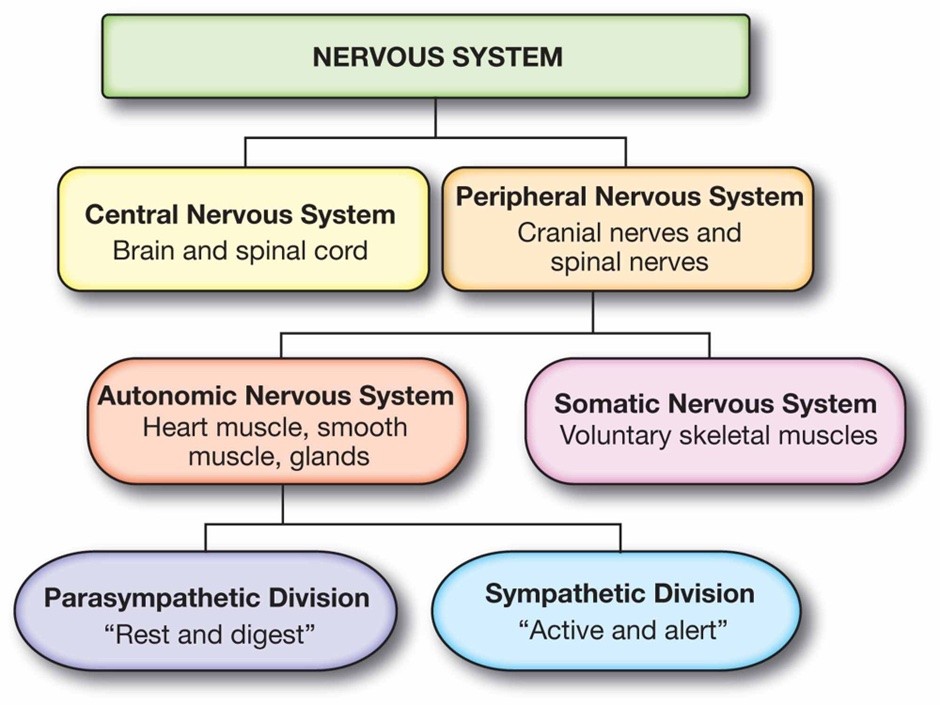
The Central Nervous system, C.N.S (brain and spinal chord) is responsible for receiving, processing and storing incoming sensory material. Once interpreted commands are sent to the peripheral nervous system (P.N.S). Its main role is to relay messages between the Central Nervous System (CNS) and the body’s muscles, organs, and senses.
The Peripheral Nervous System is divided into: the Somatic Nervous System, which controls voluntary movements by carrying sensory information to the CNS and motor commands to skeletal muscles and the Autonomic Nervous System (ANS), which manages involuntary internal functions like heart rate, digestion, and gland activity.
#### The Autonomic Nervous System (ANS)
Our nervous system is concerned with identifying whether our environment is safe or not right now. The automatic nervous system plays a key role in this. It is in turn divided into the Sympathetic and Parasympathetic systems. Understanding how these systems work can be very helpful for developing balance and resilience.
[](https://rebeltoolkit.extinctionrebellion.uk/uploads/images/gallery/2025-10/flowchart-nervous-system.jpg)
#### Useful theories for working with our autonomic nervous system
There are two theories that have come from work with people suffering from trauma (developmental or post traumatic stress) that can give us some pointers about managing our stress levels.
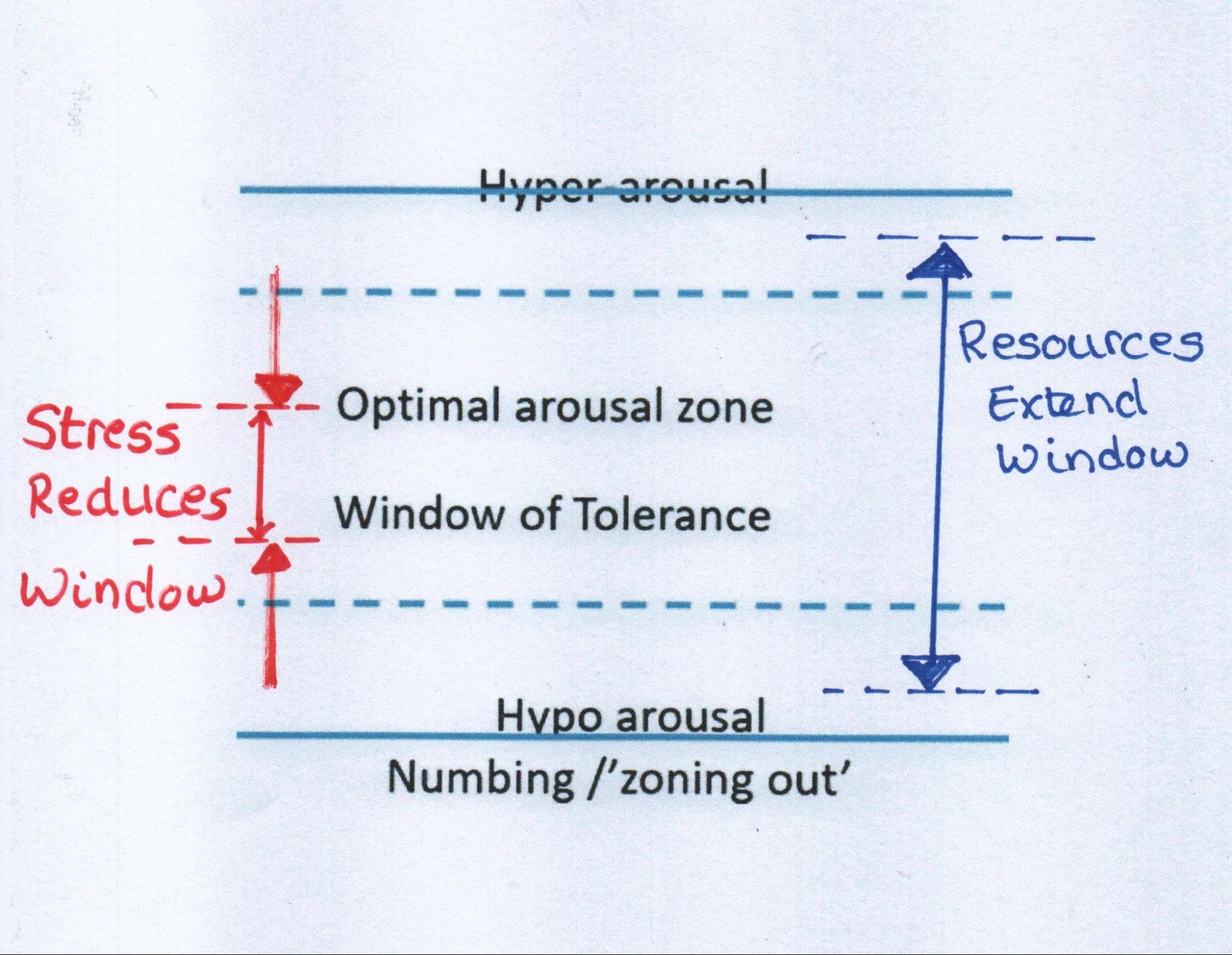
One of these, called the “window of tolerance”, describes a zone where we can manage our experience and emotions in a balanced way.(Dan Siegel) It can be usefully connected to another concept, the polyvagal theory (Stephen Porges).
The polyvagal theory helps us understand the role of the Automonic Nervous System (ANS) in balancing our emotional states and in social connection.
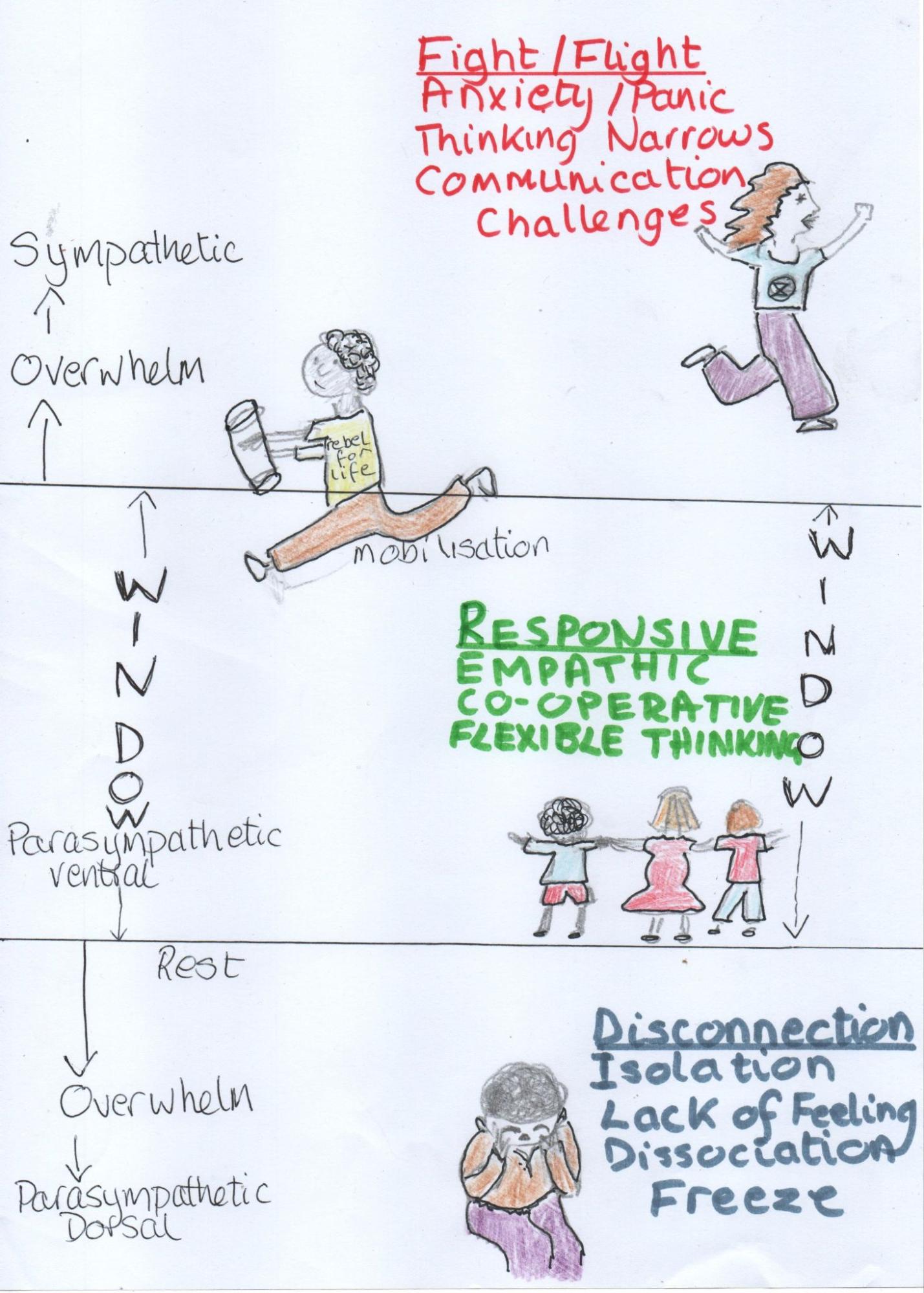
The polyvagal system outlines three basic emotional states:
- the social engagement system (ventral vagal/parasympathetic not necessary to remember!);
- the flight or flight response (sympathetic nervous system);
- the shutdown or freeze response (dorsal vagal/parasympathetic).
Combining these two theories — so matching the “window of tolerance” with the social engagement system of Porges polyvagal theory — gives us an understanding of the way our nervous system responds to stress and danger (perceived or real). It also helps us understand how best to take care of ourselves so we can manage challenging situations more easily. See diagram below, the “window of tolerance” being between the dotted lines.
[](https://rebeltoolkit.extinctionrebellion.uk/uploads/images/gallery/2025-10/diagram-window-of-tolerance2.jpg)
We can begin to be aware when we are moving into states of fight or flight, or into a place of shutdown or freeze, and take steps to wisely support ourselves when this is happening. We can learn to integrate practices and behaviours into our daily lives that support our ability to manage the various challenges that we are faced with. We can also use some of these practices to support our ability to respond wisely and effectively in potential situations of acute threat, e.g. when taking non-violent direct action (NVDA).
[](https://rebeltoolkit.extinctionrebellion.uk/uploads/images/gallery/2025-10/stress-responses.jpg)
**Neuroscience has helped us identify particular things that help us move into our “window of tolerance”.**
#### Being with Safe Others
This can mean building up connections and friendships in our daily life. Our nervous systems are soothed by feeling like we belong. These relationships can be with people or other beings.
When taking action it is helpful to be part of an affinity group where everyone can feel confident that they are supporting each other in your different roles. In order to keep this sense of connection, check-ins before action and debriefs post action are really helpful.
#### Mindful awareness
Using our senses of smell, hearing, taste, sight and our felt sense we can pay attention to what is happening in our experience moment-by-moment. “Coming to our senses” in this way helps move us into a calmer state and helps us move away from ruminative or catastrophising thinking.
Developing or practising “somatic awareness”, such as tuning into our breathing or the sensations in our bodies is a very helpful way to settle ourselves. There are many practices; from yoga and tai chi, breathing exercises and other somatic practices that can help. You can find some of these in the resources section of this doc.
Establishing a mindfulness meditation practice can also be a useful way to calm the nervous system. It is also really helpful in supporting us to understand when and how we get triggered into flight, fright or freeze.
#### Exercise or movement
Exercise of all kinds from jogging to dancing is very helpful in breaking down the stress hormones and producing endorphins that promote a sense of wellbeing and positive mood. When at a direct action, taking time to move or even just give the body a good shake or shimmy can be a great way to feel calmer.
> This is a brief summary of how we can use our understanding of our nervous system to look after ourselves, and you will find much more on this subject with a little research. If you are super interested in this area we would recommend a book on working with trauma called ‘The Body Keeps the Score’ by Bessel van der Kolk.
# Burnout
A potential result of too much stress, a lack of self care, or not taking care of our boundaries is burnout.
**Burnout feels very different to stress**, when we might feel under great pressure physically and mentally. However, when we are stressed we can still imagine that if we can just get everything under control, we’ll feel better.
We are in the fight and flight/ sympathetic part of our autonomic nervous system (ANS).
**When we go beyond stress into burnout**, there is a complete lack of motivation and energy. We feel flat, mentally exhausted, and stop caring about the things that were so passionately driving us. We become averse to looking at messages or answering emails. We believe there is no hope in positive change. We are in the collapse part of the Autonomic Nervous System (see [How we Tick](https://rebeltoolkit.extinctionrebellion.uk/books/rebels-personal-regenerative-work/page/how-we-tick)), the dorsal parasympathetic. It feels similar to situations where people have undergone a huge shock or experienced a traumatic event.
**We don't always recognise we are in burnout** and to make things worse, the fact we are in a shut down state can mean we isolate ourselves and don’t reach out to others or ignore their reaching out to us. Sometimes we may experience a sense of failure or badness, or feel resentful or let down by others.
**Burnout can also have a long term health effect on immunity and sleeping**.
Obviously it is best if we can pay attention to our boundaries and self care needs but sometimes it feels like a bit of a balancing act and it takes practice to find a balance that is right for us as individuals.
So it is really important that we are aware of the signals of burnout and take action to address them.
#### Signs and symptoms of burnout:
##### Physical signs and symptoms:
- feeling tired and drained most of the time,
- lowered immunity and frequent illnesses,
- frequent headaches or muscle pain,
- change in appetite or sleep habits.
##### Emotional signs and symptoms:
- sense of failure and self-doubt,
- feeling helpless, trapped, defeated,
- detachment, feeling alone in the world,
- loss of motivation,
- increasingly cynical and negative outlook,
- decreased satisfaction and sense of accomplishment.
##### Behavioral signs and symptoms of burnout:
- not completing tasks,
- ignoring messages,
- skipping meetings,
- isolating yourself from others,
- procrastinating,
- using food, drugs, or alcohol to cope,
- taking your frustrations out on others.
# Personal Resourcing Menu
### Develop a Personal Resourcing Menu
We can build a toolbox of things we can do in order to get support and nurture ourselves. We can call on this when we are moving into a place of overwhelm. In this way we build our resources and develop resilience.This is also a way of learning how to access our window of tolerance and increasing our capacity for managing challenges (see [How we tick](https://rebeltoolkit.extinctionrebellion.uk/books/rebels-personal-regenerative-work/page/how-we-tick)).
We might build a list of immediate things to do, as well as a longer term list of things that might take more time to arrange.
**Immediate resources** - these are just a handful:
- Enjoy a hot drink
- Take a bath
- Try breathing exercises
- Sing
- Go for a walk or a run
- Take some mindful time in nature
- Do some stretching or movement
- Try some gardening
- Have a hug with a friendly human or pet
- Have a cuddle with a weighted blanket
- Make time for a chat with a fellow rebel or other friend
- Listen to soothing/upbeat music
- Watch your favourite film
**Longer term resources** - here are a few suggestions:
- Join a support group
- Meet with a friendly rebel online or in person
- Join some local social events
- Access the TESN (Trained Emotional Support Network) rebel-to-rebel listening service
- Contact the Climate Psychology Alliance (CPA)
More info can be found here: [General Support Options](https://rebeltoolkit.extinctionrebellion.uk/books/resources/page/invitations-for-self-care) and [Support for People of Colour](https://rebeltoolkit.extinctionrebellion.uk/books/resources/page/support-for-people-of-colour).
Make space for regular enjoyable, nurturing activities on your own or with others. Adopt a regular practice that provides some balance and ease - tai chi, yoga, stretch or exercise class, meditation, a bodyscan, somatic practice, a sit spot (a local spot in the garden or green area to spend time simply noticing your surroundings with all your senses), journalling.
Build in a **regular habit for a check-in with yourself** where you can take time to reflect on how you are feeling, noticing the things on your mind and your heart, listening to the body to notice signs of tension or messages wanting your attention.
[](https://rebeltoolkit.extinctionrebellion.uk/uploads/images/gallery/2025-10/kids-on-grass.jpg)
# Invitations for Self Care
1) I can give myself the same care and attention that I give to others.
2) I am not an endless 'resource' for others. I must stock up on
'reserves' and not get too drained.
3) I have needs too, which may be different from my family's, my friends’ or my colleagues’.
4) I do not have to say 'yes' to all requests or feel guilty if I say 'no'.
5) The 'perfect' person does not exist, making mistakes is permissible; I can learn from them, as can others.
6) I can't solve all the problems I'm confronted with. I can only do my best.
7) I have the right to be treated with respect as a worthwhile, intelligent and competent person.
8) I do not have to have everyone's approval all of the time to know that I am trying my hardest.
9) Time for unwinding is time well spent.