Relationships with Wider Ecosystem
Attending to relationships with other-than-humans.
- Introduction
- Being and Belonging in Nature
- Sacred Activism
- Council of All Beings
- Including other-than-human voices in governance and decision-making
- A Walk with Gaia
Introduction
Restoring land without restoring relationship is an empty exercise. It is relationship that will endure and relationship that will sustain the restored land.
— Robin Wall Kimmerer
The source of all regenerative culture is living nature.
Western civilisation has separated culture from nature and defined non-human beings as “things” or “objects” and humans as the central “subjects”. Western thinking is largely exclusive (what suits particular humans) and resource oriented. Darwinian theories of nature have overemphasised competition and not paid enough attention to the many dependencies within which competitions play out.
However, the ecological crises that motivate us to Rebel against Extinction demonstrate that this thinking is faulty: culture and nature are not separate, we are deeply entangled with life.
Take an individual as an example, maybe ourselves - we make the individual that is us, by taking in air/feeding from other life while at the same time providing carbon dioxide, skin cells and waste that creates more life. We are part of life, we are nature.
Another example is the water cycle. All the water in the world has always been here, it cycles through humans and other beings, returns to the rivers and the seas, evaporates, becomes clouds and rain or snow and enters into bodies by being drunk or as droplets in breath, in endless cycles of regeneration.
Our ancestors recognised this and many Indigenous societies live in this way. When we see life as a web of relationships, we understand that reciprocity (mutual dependence) is needed for all to thrive.
We can be guided by some principles that can be identified in Indigenous cultures:
- We all have to work together: “I am because you are” (Ubuntu philosophy).
- We want reciprocity (giving and receiving).
- Everything has life.
- We can understand reality by taking part in its aliveness (with our body i.e. not theoretical).
- Rather than the focus on postponing our individual death, we focus on keeping the world fertile and diverse.
In a world of connections, we are not lone individuals set against one another, we collectively create the whole process of life. The collective is as important as the individual and the ways, and thoughts, and desires of non-human beings cannot be left out.

There is more to explore around this topic- if you are interested, you could start with the work of Andreas Weber.
Being and Belonging in Nature
Today the only things you can enter into relationship with are other humans. Yet the human nervous system still needs the nourishment that it once got from being in reciprocity with all these other shapes of sensitivity and sentience … nourishment that we once got from being in relationship with dragonflies and swallowtails and stones and lichen and turtles.
David Abram
We could see the ecological crisis as a “crisis of belonging”. Perhaps we have not taken care of our world because we don’t feel ourselves as part of it. Perhaps it is because we have been taught to view land as a resource or scenery and other forms of life as “objects”.
We are all aware of the wellness industry that sells nature as restorative. We can go into natural environments to see something or get something or have a special experience.
Can we learn to take our place again as part of nature? To deeply recognise we are part of nature whether we feel that we are or not? Perhaps we may feel separate and longing to connect/reconnect with the rest of the earth or perhaps we may feel intricately part of the web of life. Is there a way we can begin to experience other beings as family, as kin? Can we relate in a way that isn’t about taking something, that is just about relationship for relationships sake?

Here are some ways we can begin to reconnect with our other-than-human kin, strengthening our animal aliveness which favours reciprocity, emergence, and sensuous awareness.
Paying Attention
 Simply spending time with other-than-human beings. Using our senses, looking, listening, touching, smelling. However, doing this with respect, many animals, for instance birds, do not like to be watched directly. As with other relationships we may take **time** to approach other beings, “listening” with our whole selves and being prepared to change in response. Not assuming every tree wants to be hugged!
Learning about the beings you see can help develop a sense of relationship – e.g. for birds, learning their calls, their colours, the way they fly, their homes - or for trees, learning their shape, their leaves, where they belong, how they interact with the breeze.
Sit Space
There is a simple practice called a 'sit space' suggested by Jon Young. He says:
Find one place you can get to know really, really, well. This is the most important routine you can develop. Know it by day; know it by night. Know it in the rain and in the snow, in the depth of winter and in the heat of summer. Know the stars and where the four directions are there. Know the birds that live there; know the trees they live in. Get to know these things as if they were your relatives, for, in time, you will come to know that they are!
Find a space outdoors to sit for ten/fifteen minutes each day without interruption. Observe everything around you, eyes, ears, and nose.
- It needs to be close to your house.
- Somewhere that you feel safe.
- it is more important that you can get there every day than if it looks pretty. If at first you feel agitated and distracted, try sitting for a shorter time and increase gradually. Some of us might find we need time to settle before we can really pay attention and want to sit for longer. Notice how your relationship with your sitting spot and the “kin” you find there changes as you get to know it.
Offer a Gift
As part of repairing our relationship with other beings, which has been one of extraction (taking more than we give back and often giving nothing back) we can start a practice of reciprocity (mutual sharing) by offering a gift.
This can be practical e.g. giving food (where appropriate) or clearing rubbish from a river or removing litter from the living places of our non-human kin.
Or it can simply be a gift of appreciation - an arrangement of leaves or wild blossoms, a song or a poem. We of course need to make sure that anything we leave in nature is not harmful and must be biodegradable.
Establish Small Rituals
For some of us, the talk of rituals will sound just weird. However, we are not talking about bloody sacrifices here, we are simply meaning carrying out activities that reconnect us to the rest of the living world, to the seasons, to a sense of place, to an appreciation of other kinds of life.
We may be drawn to reconnecting with pagan practices of celebrating the year's cycle, the moon, the solstices, Samhain, Beltane etc or the old festivals still recognised across the UK such as apple wassailing or a harvest celebration.
You may want to create your own ritual, for example going to sit with the toadstools that emerge in your local woodland when they appear each year, or greeting the same tree.
Or we might choose to sit in a place damaged by humans, an old industrial estate, a piece of disregarded wasteland and offer a sense of friendship to that place. How is it to sit in a part of nature that isn’t beautiful?
During lockdown, London rebels circled and named in chalk those plants coming up between the pavement stones (sometimes called weeds) as a way of celebrating them.
The XR World Water Wedding Campaign is based on a ritual that is about acknowledging our deep relationship with water and expressing our gratitude. Water is Life.
There are many ways to remake our relationship with Earth. Surely this is our rebellion too... a rebellion of belonging!
Sacred Activism
Sacred activism is an important component of XR, as XR aims to actively heal and revitalize the planet, going beyond sustainability to actively improve and enrich ecosystems and communities. Sacred activism, with its focus on integrating spirituality and mindful awareness into social justice work, provides a framework for this holistic approach. Perhaps Sacred Activism holds a capacity that other forms of activism may not encourage? Perhaps Sacred Activism supports individuals to find inner strength and connection to the earth, which then fuels their actions for positive change.
- Sacred Activism draws on wisdom traditions, integrating activities like mindfulness, meditation, embodied relationship and compassion into activism.
- It recognises that personal growth and spiritual development are essential for creating positive changes in the world.
An intersection between inner and outer change. An openness to support from forces currently invisible to us yet felt. - It actively works towards a more just and equitable world, addressing issues like inequality, environmental degradation and social justice.
- It emphasizes the importance of love, empathy and kindness in all actions taken to create positive change.
- It recognises the interconnectedness of all things and seeks to address the challenges in a holistic way, integrating personal, social and environmental well-being.
Ritual
In sacred activism ritual is purposeful practice, often involving symbolic actions and ceremonies, that aim to connect with the spiritual realm and enact change in the world. It’s a way to ground oneself, express intentions and collaborate with currently unseen forces to manifest positive change within individuals and the collective.
Rituals in this context are not just symbolic actions but a way to connect with the sacred – whether it’s the earth, ancestors or spiritual forces. They are used to express intentions, prayer and desires for positive change, acting as a bridge between the spiritual and physical worlds.
- Rituals can help shift individual collective consciousness towards a more harmonious relationship with the earth and each other. In these ways ritual and ceremony are often harmonious bed fellows with the alliances between the human and other than human worlds.
- Through collective participation and symbolic actions, rituals can amplify the power of individual intentions, creating a stronger field of energy for change.
- Rituals can challenge and subvert dominant narratives that perpetuate inequality, exclusion and environmental degradation.
- Rituals can foster a sense of community, belonging and shared purpose, strengthening the collective for action.
- Rituals in sacred activism can range from simple actions of grounding and intention-setting to elaborate ceremonies involving prayer, song, offerings and symbolic actions, often tailored to the specific context and goals.
In essence, ritual in sacred activism is a powerful way to harness spiritual energy, amplify intentions, and create meaningful change in the world by connecting with the sacred and fostering a more just and sustainable future.
PLEASE NOTE: For some rebels ceremony and ritual are vital and for others this is seen as ‘weird and wacky’. We acknowledge the range of individual differences across the XR community as a strength of our shared approach.
Ceremony
A sacred activism ceremony may involve a community coming together to perform a ritual, like a fire ceremony or a prayer circle, to express solidarity, send healing or call for change. The ceremony is held with a specific purpose relating to social and/or environmental justice.
Ceremonies often incorporate elements of prayer, meditation, chanting or other spiritual practices to connect participants with their inner selves and with a higher power or universal energy. These bring people together to share their intentions, offer support and create a sense of collective power.
Participants may engage in symbolic actions like lighting candles, offering gifts (food, incense, water) , creating art or performing a symbolic play to represent their commitment and hopes for change.
Sacred activism ceremonies are not just symbolic; they are meant to inspire and strengthen participants for real-world action. They can be a way to process emotions, build resilience and find renewed motivation for ongoing activism.
Practices of sacred activism invite a different way of understanding and a different method through which their actions and decision making may be guided. Ceremonies give us an opportunity to pause; to take time out of the often habitual and unconscious busyness of everyday life so prevalent here in this western culture. To slow things down. To bring the body and mind together as we move our bodies through gestures and postures that amplify the words that we speak e.g. when we actually bow to the four directions we actually turn our body to face different directions. As we do so, we may actually feel the warmth of the sun on our face as we turn to the south, perhaps and the breeze as we actually turn towards the north etc.
Ceremony may have a performative element to them, but is that the main intention? Perhaps ceremonies can be opportunities to pause and be present to what we do not yet know. Perhaps ceremonies are ways of opening us up to new in-formation coming to us, more creative innovative responses. Open to being guided by forces that cannot yet be seen but are felt by us. Open to the non-conceptual support that is already here for us? Opening to being changed and transformed maybe.
Of stepping outside of the ‘voice in the head’ and into the guidance of something other than the intellect. Something bigger and more universally or elementally felt by others perhaps?
Examples of a Ceremony
A Fire Ceremony
- Find an area outside or indoors
- Imagine a circle of protection around everyone.
- Invite in the spiritual power or energies that you wish to be with you.
- Reflect on what you wish to release (negative emotions, limiting beliefs etc) and what you want to invite into your life
- On a piece of paper write down the things you long to release and those you want to invite. You could include gratitude for what you’ve learned.
- Build your fire with reverence, taking time, slowing down, adding kindling and gradually larger pieces of wood.
- As you place each item in the fire perhaps you are inspired to visualise the release of the old and the manifestation of the new. Speak your intentions aloud or silently as you offer them
- Take time for meditation, grounding and reflection for integrating the experience. This could be spoken.
- Close the circle and say goodbye to the spiritual power or energies.
Video:
A workshop about Sacred Activism delivered by Jonathan from UK XR Sacred Activism
Council of All Beings
Introduction to a Council of All Beings practice
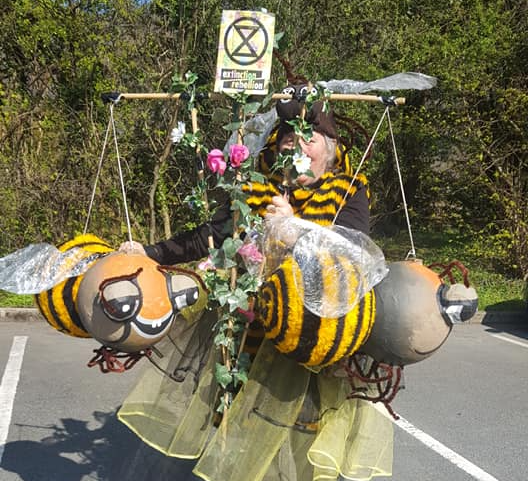
'Council of All Beings ' is a 'Work that Reconnects ' deep ecology practice from Joanna Macy and John Seed. This group process strengthens our direct experience with other beings. It invites us to step back from our human identity and speak on the behalf of another form of life, an animal, plant or a feature of the landscape eg.river. We then represent these beings at a gathering called a Council.
We can view this as a way of building empathy with another aspect of nature or a ritual in which we allow other beings to speak through us.
We take time “to be chosen” by the being we are going to represent, this might be in silent contemplation or through spending a time of silence walking or sitting in nature. We then take time silently to make masks to wear that represent the chosen being.
At the appointed time we join in a circle of “Council” and listen as each being is invited to speak in turn.
This can be done as a regenerative practice in your local groups or regions/nations or as part of a larger rebellion. Here is a suggested format for holding a Council of all Beings.
Welcoming of group & Agreement
We welcome all parts of all the participants, e.g. certainty, uncertainty, fear, joy. We agree to co-create a safe container of confidentiality, consent and compassion.
Landing/ Trust Building
Brief check in with names then a word of how we are, something you are grateful for in the last 24 hours, or a concern about being alive at this time.
Setting the scene
Outline the practice.
Invite awareness of the seasonal context.
Or tell a local story or myth of the natural world.
Or if familiar one of the practices of the work that reconnects e.g. Beings of three times.
Connecting with a Being
In this process, we imagine that other beings, other life-forms apart from humans, seek to be heard at our Council. The participants take time alone to let themselves be chosen by a life form. Ask people to relax deeply, opening their mind wide like a radar dish.
Encourage people to stay with the first impulse that arises. It is not a question of choosing a species one knows a lot about, but rather allowing oneself to be surprised by the life-form that comes, be it plant, animal, or ecological feature, such as swamp or mountain - basically any nonhuman being. Suggest that they visualize this being fully and from every angle, its size and shape and ways of moving. Then they request this being’s permission to enter it, so they can imaginatively sense its body from within. Finally, they ask the being how it wishes to be represented.
Practice moving and speaking as the life-form. If time allows, this practice session helps people identify more fully with their life-form.
The following activity can help ease our self-consciousness.
The guide invites participants to start moving as their life-form.
Breathing easily, begin to let yourself feel how it is to take body in this new life form.
What shape are you?
- How much space do you take up now?
- What is your skin or outer surface like?
- How do you take notice of what is around you?
- How do you move, or are moved?
- Do you make any sounds? Play with those sounds.
Inauguration of Council
The Council is called and participants join in a circle.
These words can be spoken to open the Council: "Welcome all, to this special Council. Gather now in this hour, join with us now in this place. We hope to hear your views, concerns, stories, sorrows and inspirations."
Round 1 - Introductions
The beings move to the Council ground “in character” when summoned by drum beat or animal call. When they are all in the circle, the guide, as her adopted life form, welcomes them to this council on what is befalling their Earth and their lives.
She invites them to identify themselves. Each being introduces themselves as the aspect of Nature they have chosen, e.g. “I am River, I speak for the waterways" or “I am swallow and I speak for the migratory birds”.
Round 2 - Voice concerns (humans are invited in to listen)
-
Now, speaking at random, the beings express the particular concerns they bring to the council. For example:
As River: “My waters are polluted, and thrown away plastics float upon my surface…”
The Beings in the Council respond with “We hear you, River.”
-
After a while, the guide reflects that all the suffering that the beings describe seem to derive from the activities of one adolescent species. “It would be good for humans to hear what we have to say. Let us summon them to our Council, to listen only. Would five or six of you put down your masks and move to the centre to be humans?” They are addressed directly: “Hear us, humans. This is our world, too. And we’ve been here a lot longer than you. Yet now our days are numbered because of what you are doing. Be still for once, and listen.”
After a time, when more beings have spoken, the drum beats again and other humans replace the ones in the centre. In this way, everyone takes a turn to listen as a human.
Round 3 - Offering gifts to the humans
When all the beings have had a chance to address the humans and call them to account, the beings then offer resources to the humans.
The guide may say “For all their machines and apparent power, the humans now are frightened. They feel overwhelmed by the momentum of the forces they have unleashed. It does not serve our survival for them to panic or give up, for truly our life is in their hands. If they can awaken to their place in the web of life, they will change their ways. What strengths and gifts can each of us give them to help them now?”
Each being has the chance to offer to the humans, and receive as a human when they come to the centre, the powers that are needed to stop the destruction of the world, the strengths and gifts inherent in each life-form. Sometimes the humans break their silent listening to say simply “Thank you.” “I, Wild Flower, offer my fragrance and sweet face, to call you back to beauty. Take time to notice me, and I’ll let you fall in love again with life. This is my gift.”
Ending
Councils can come to a close in different ways.
Reflectively in silence.
With hugs or sounding together when everyone has joined the humans in the centre to receive the gifts.
With drumming and dancing, with hoots and howls and other wild calls.
In whatever way the Council ends, a formal letting go and thanks should be given to the beings.
People are asked to speak to the life-forms they adopted, thanking them for the privilege of speaking for them, and then letting that identity go.
The participants may be invited to place their hands on the ground, returning the energy that has moved through them to the earth, for the healing of all beings.
The participants can be invited to place their hands on the ground, returning the energy that has moved through them to the earth, for the healing of all beings.
Including other-than-human voices in governance and decision-making
There is a growing movement encouraging the representation of nature within governance structures. A person within the council, board or trustees will speak for nature, whether that’s speaking for the rivers, forests or specific animals.
This idea is a development of Joanna Macy’s Council of All Beings, an exercise in which people represent different beings in a council and are encouraged to speak from that being’s perspective on a topic.
This idea can give ecosystems or animals rights within human decision-making systems. Nature or an aspect of nature can have legal personhood and can be represented in legal contexts. This is a way of including nature in any planning and policy-making.
Here are some examples of this in practice:
- Councillors in Sussex approved a charter in February 2025 recognising the right of the River Ouse to flow, to be free of pollution and to have native biodiversity.
- In Wales, the Future Generations Commissioner ensures that the interests of future generations are considered in policy-making. The office evaluates the long-term impacts of current policies and promotes sustainable development practices aimed at safeguarding both human and environmental health.
- In Ecuador, the 2008 constitution was the first in the world to grant legal rights to nature, or Pacha Mama (Mother Earth), to exist and regenerate its life cycles. A case in 2022 used these rights to challenge mining concessions that threatened a protected forest.
- The Yurok tribe in the USA declared the Klamath River a legal person.
- In 2010, Bolivia passed the Law of the Rights of Mother Earth, defining nature as a collective subject of public interest with inherent rights
- In 2017, the New Zealand Parliament passed an act that recognized the Whanganui River as a legal person, or Te Awa Tupua. The law was the result of a settlement with the local Māori iwi (tribe) and established a co-governance structure with representatives from both the Māori and the government acting as the river's legal guardians.
- The Snæfellsjökull glacier was nominated to run in Iceland's 2024 presidential elections as a symbolic way to bring nature's interests into the political conversation.
There are also various organisations working to advance this concept. The Planetary Democrats asks for democracy for all.
All beings and ecosystems on Earth deserve political representation. To solve planetary challenges we propose the implementation of a Planetary Parliament (from Planetary Democrats website)
Animals in Democracy is building a network of partners to strengthen political representation of animals.
Organisms Democracy and Embassy of the North Sea create immersive experiences, inviting people to engage with nature directly through interactive art and role play, from microorganisms to ecosystems, helping them view the world through new, and sometimes surprising lenses. These encounters encourage participants to step into the perspectives of non-human entities.
A Walk with Gaia
Here you will find the instructions for a guided practice of connecting more deeply with earth.
This journey will take you through various layers of the living organism of earth enabling you to connect in a deeper way with our planet, its magnificence, its interconnectedness, and your relationship and place within the larger whole.
You will be asked to imagine yourself in places where it would not be practical to be physically, so just allow that experience to unfold for you in your own unique way. As you journey the vitality of the earth will become increasingly present to you as you experience it as it is, rather than in the way we preconceive it. So, just allow yourself to slowly and gently open to those possibilities.
Preparation
The practice will take about an hour. It will involve spending some time out in greenspace in an area that is quiet and where you will be able to settle down either sitting/leaning with your back to a tree or lying on the ground. This will be during the middle of the practice, with the beginning and the end being a walking/wandering practice. So, it would be best to select a time of day where few people are around to disturb you, and/or an unpopulated area within the greenspace.
Make sure you are appropriately dressed for the weather as you will be still for some of the time. You may want to take an extra layer for the sitting/lying part, together with something waterproof to lie on. You may want to plan the walk so that you know beforehand where you want to settle down against a tree or lie down, so you don’t have to search for a place during the journey. Also bring a journal if you wish to record the experience at the end.
Ideally the practice should be conducted with eyes closed, particularly for the sitting/lying down part, as the connection will work better without day to day visual incursions. Obviously keep your eyes open when walking! But you may be able to tune into other creatures and plants better if you soften your gaze or close your eyes. If you do not feel comfortable with closing your eyes when settled down, allow yourself to lower your eyes and gaze in an unfocused manner.
Before you start your walk, take three slow breaths and settle into yourself, letting go of day to day concerns.
First Steps
The earth is our home. As you start your first steps, reconnect with the understanding. It is our home, It provides for us. It offers us oxygen, water, plants and animals for food and nourishment, and provides us a rich and continually changing ecosystem to offer us an environment where we, as humans, can unfold our possibilities in partnership with all creation. We are part of it. There is no such thing as nature separate from us. We are as much a part of earth as the soil we stand on.
Now… as you walk, become aware of the life that you see around you. Human life too, if there is any. We are part of Gaia.
Notice the small animals you may see, and the birds... the trees... the plants... the insects. Appreciate each form as you see it; the specific formation of it, the colours, the sounds it may make, the way it moves. The smells too.
As you notice each living being, animate or not, just spend a little time becoming more deeply aware of it. What are its needs? How does it connect to other parts of the ecosystem? What does it bring to the whole in its richness?
Just spend a little time as you walk or wander communing with whatever being your attention alights upon, be it animate or inanimate. What drew you to that being? What would it feel like to be that creature or plant? Don’t expect to get clear-cut ideas or messages necessarily. The level of connection you are making does not occur at a thought-based level. It may come fleetingly, as a body-based experience - it may pass through your awareness in the form of a colour, a sense on the skin, a subtle feeling in your body, or just as a ‘knowing’.
Visit a few different plants or follow a few creatures. Just allow your body to lead you.
Settling Place
Now, as you walk you will be finding your way slowly towards your settling place for the middle part of this journey. As you step slowly and gently across the ground, become aware of how your feet land on the earth. Notice each part of your foot as it makes contact with the ground. Start to become aware of the teeming activity right under your feet. Activity that we take for granted normally, but on which all life on earth depends.Once you have found your place, get yourself settled. You will be here for about 15 minutes, so you may want to take a little time getting yourself comfortable.
As you become settled, return to your breathing and take three slow breaths again.
Journeying Down
Now become aware of the ground underneath you. You are connecting to the less dynamic forms of the earth now. The ground beneath you is a mixture of inorganic and organic matter and a myriad of living microscopic beings. Together they form a complex system, completely interdependent to form the matrix on which the more dynamic forms of life, including ourselves, depend.Feel how supported you are as you settle down. Allow your limbs to relax. Release any tension in your face and shoulders. Ensure your position is sufficiently comfortable to stay here for a while and make any adjustments now.
Now move your awareness down into the soil below you. This part of the journey will depend on your imagination. Imagination takes many forms. Some people can see a ‘visual’ representation. For others the imagination operates in its own way, maybe offering physical sensations, a whole body ‘felt-sense’ or just a ‘knowing’. Just allow your imagination to unfurl in its own way. There is no such thing as a complete absence of imagination- it just happens in a way that is unique to you.
So, as we move down into the body of the earth, allow your attention to move down into the soil about 10 to 15 cms. Become aware, in your own way, of the multiplicity of activity that is emerging there, as the creatures and other matter interact, creating complex webs of creation. Become aware of how this is always happening below your feet, wherever you are, every minute of the day, even if you are normally in a multistorey building. Life carries on its teeming way just below your feet.
Now take your attention and awareness deeper into the soil, down to the subsoil, as the level of activity of animate creatures subsides. There is still activity here, but it is slower, and something we are less aware of normally. Notice your experience as you become more aware of this deeper and slower pace of creation.
Slowly move your attention deeper... to 3 metres... to 10 metres... to 100 metres… You are moving through the crust. Notice what your own experience is as you move through the crust. Not what science tells us, but what impressions you have as you journey through it.
Now we are moving deeper and deeper in towards the centre of the earth. Science has explored it from a rational point of view. In this exercise I suggest to you that you may want to let go of what science says about the role of the various layers of earth and see what experience you have of it. What do you experience as you journey through the inside of the earth? How do you connect with it? Does it have a sense of touch? A smell? Does it emanate a sound? Are there colours that you see, does it evoke a bodily sense? An emotion? Maybe there is something else that you are noticing.
Take this at your own pace.
Centre of the Earth
Now you coming to the centre of the earth, the focus of everything that has happened here on earth. Now, as we arrive at this place we have the opportunity to reflect and become aware of our place in the cosmos in this living planet which has existed for eons, before microbes arose, before plant forms developed. This wonderful planet has emerged into an extraordinarily complex living organism supporting innumerable forms of life and consciousness, over unknown periods of time beyond our comprehension.
Here we can start to become aware of the emergent nature of life, of the developing complexity of consciousness, of the network of interrelationships that have arisen as earth has developed.
At the current stage of our science we are starting to become aware that the basic building blocks for physical existence derive from quantum processes, which, in themselves, contribute and respond to the development and interaction of consciousness. There is a mutuality in relationship in the quantum processes and the development of life.
What we are able to measure at a physical level is a minute part of what is actually going on within the physical reality of which we are a part. Increasingly, through science and also direct experience we are becoming aware that there are processes and activities that we experience that we cannot quantify and cannot yet substantiate. Each of us will have different fleeting experiences which we can choose to ignore and set aside, or we can notice them and embrace them as they add to the richness of our lives and to the whole of our planet.
So, as we are now at the centre of the earth, as much in imagined perspective as in a conceptual way, we have the opportunity to take a fresh look at how we perceive life. Let us now take the return journey with a new view of the nature of our world, being aware of it from the perspective of consciousness, and including hidden layers of consciousness, the parts that cannot be measured but arise from energies that interact with our physical atomic view of the world.
As we move back then, let’s open our perception out. Let’s recognise that there may be far, far more going on than we have given credence to. Expand your awareness, as if you were looking out with your peripheral vision, right on the edges of your vision. But we are not doing this with our eyes, we are doing this with our awareness. Every part of our body consciousness is now opening up to an expanded perception of what our home is. What the hidden processes might be, some which we may experience fleetingly, others beyond our perception and conception. What networks of interactions may there be occuring.
Journeying up
So, let’s make that journey back, not to the same place, but to a fresh place, overlaid on your original starting point, a greater and deeper recognition of the whole complex system of earth and our interconnectedness with it. During this return journey we can open up to a broader way of being than we normally adopt in the mundane world.
We are aware that we cannot separate our consciousness from our environment. Scientific experiments confirm that we cannot help but influence the outcome of experiments. Our very existence in the world affects what happens.
And, also, science is beginning to show that there are many biological processes within our bodies that cannot be fully explained within the classical science framework. We may not yet have scientific theories and instruments to explore these realms adequately, but we can use our own consciousness to open ourselves up to a sense of something more than just what we can currently physically experience. This is where an imaginative and metaphorical journey can start opening up possibilities.
So, allow yourself to journey back, very slowly and at your own pace to the world we normally inhabit. As you journey back, allow for the possibility of the unseen consciousness and energies that we have always ignored becoming perceivable in your broadest awareness. Just allow that expanded way of being in the world to unfold. Don’t push for it, but allow it to just creep in. It’s a matter of practice, it rarely happens in a flash.
As you make your way back to the surface of the earth, to our world we live in, in the here and now, notice how things may have changed for you. How do you feel now? Is there a difference? Maybe you can sense there is, but it cannot be put into words. That will probably be the case, because you have been experiencing something which we do not have a vocabulary for, because we have not needed to, and because everyone has a different and unique experience.
Back on the Surface
And as you approach the crust again, you may be more aware of the activity there, the matrix of activity. How we relate to the earth becomes much more evident here. Because as there are connections between all the components on earth, we also affect those connections in our own individual and collective actions.
As we become closer and closer to the surface of the earth the strength of our consciousness has an even greater impact on the activity below the surface. Our thoughts, our actions, our emotional state - all these affect the relationships with the layers of the crust and the overall health of the entire ecosystem, including us.
So explore how you interact as you journey through the crust. Notice how different the experience may be for you. You may want to pause again briefly to take in that change in perspective.
And now, you approach the surface of the earth, where you are resting.
As you return to the here and now, become aware of the feeling of your body touching the ground. Notice the sensations in your hands where they touch their support. Notice the sounds near to you…. And then further away. Sense anything else, wind, temperature? Before you open your eyes, or lift your gaze, just notice how you feel now in the broadest sense of that word, ‘feeling’, about being where you are just here and now in this world.
Now, gently open your eyes, and stretch as you want, before looking at the world around you. Does it seem different now?
As you get to your feet again, notice any difference in the quality of sense of your feet on the ground.
Return Journey
Retrace your steps, visiting the places and plants and creatures (as is practicable) that you connected with on your outward journey. Notice how you relate to them now. What is your sense of connection to them? Do you have any sense of them having a greater connectivity with you? It is a two way process, always. As you go, perhaps you might like to reflect on your appreciation of each individual part and the collective whole of this place where we all live. And finally, and just as importantly, notice the other humans in your surroundings. They are just as much a part of this entire ecosystem we call nature, not set apart from it as discrete from it, but an intrinsic aspect of the earth’s ecosystem.Now you are back where you started, except that it is not the same place now, it has been influenced by the journey you have just taken. Neither you, nor the place, the soil, the microbiota, the insects, the plants, the trees, the animals, nor the other humans have been left unaffected by your experience.
Spend some time capturing what has been most significant to you in this empathy walk in creation.