Safeguarding
Safeguarding information for XRUK circles and the wider movement.
- Introduction
- What is Safeguarding?
- Safeguarding Children, Young People and Adults at Risk
- Who Is this Policy For?
- Who Holds Safeguarding?
- Reporting a Safeguarding Concern
- Responding to a Safeguarding Concern
- Safeguarding and Harmful Behaviour
- Safeguarding Process
Introduction
Extinction Rebellion UK (XRUK) is dedicated to creating a just and sustainable world. We believe that meaningful system change begins not only with what we demand of governments and institutions but with how we treat one another. This is contained in our Principles and Values. The culture that is built within our movement must reflect the world we are trying to create.
This policy sets out XRUK’s approach to safeguarding, including the standards of behaviour expected, the responsibilities of individuals and groups, and the processes for reporting and responding to concerns. It applies to all participants in XRUK activities, including volunteers, contractors, and anyone acting on behalf of XRUK.
What is Safeguarding?
Everyone has the right to live safely free from harm, abuse, neglect or exploitation. Safeguarding refers to the actions taken to protect children, young people and adults at risk from potential harm, abuse, neglect, or exploitation while taking part in XRUK activities. Safeguarding is everyone’s responsibility.
All participants in activities with XRUK, and that XRUK is a part of, are expected to act in ways that uphold the safety, dignity, and wellbeing of others. However, effective safeguarding also requires clear processes, defined roles, and accountability to ensure that concerns are addressed consistently and appropriately.
XRUK recognises that safeguarding measures must be applied in ways that do not themselves cause harm, particularly to those who may require the greatest protection. Safeguarding practice should be proportionate, trauma-informed, and focused on prevention as well as response.
Safeguarding supports the safe inclusion of people in XRUK activities. However, it is recognised that certain roles, responsibilities, or teams may not be appropriate for particular individuals where there is a safeguarding risk that cannot be adequately mitigated.
Safeguarding relies on trust and transparency. Where an individual has a relevant history that may present a safeguarding risk, or becomes aware of such information relating to another participant, there is an expectation that this will be disclosed through appropriate safeguarding channels. Failure to do so may result in exclusion from certain roles or activities where this is necessary to protect others.
These are relevant to this policy when used to apply to a child, young person or adult with a care or support need.
Harm: any act or omission that results in physical or psychological injury, suffering or impairment to a person’s wellbeing.
Abuse: any act or omission that results in physical or psychological injury, suffering or impairment to a person’s wellbeing.
Neglect: the failure to provide or ensure the provision of appropriate care, support or protection, resulting in risk of harm to a person’s health or welfare.
Exploitation: the deliberate manipulation or abuse of power used to gain control over another person, usually for some form of gain, including for personal, financial or sexual reasons and which results in physical or psychological injury, suffering or impairment to a person’s wellbeing.
These definitions are consistent with UK safeguarding practice, including statutory guidance such as Working Together to Safeguard Children and the Care Act 2014.
Safeguarding Children, Young People and Adults at Risk
For the purposes of this policy:
- A child is defined as any individual under the age of 16 years.
- A young person is defined as person aged 16-18 years.
- An adult at risk or adult with a care and support need is a person who may be regarded as unable to protect themselves from abuse, harm or exploitation by reason of illness, age, mental illness, disability or mental impairment. This might include adults with a learning or physical disability, a physical or mental illness, chronic or otherwise, including an addiction to alcohol or drugs, or reduced physical or mental capacity.
The safeguarding of children, young persons and adults at risk is important for XRUK. While all groups require protection from harm, abuse, neglect, and exploitation, the approach to safeguarding differs due to legal and ethical distinctions.
Adults generally have the right to self-determination and autonomy. This means adults may choose to participate in activities that carry risk, including civil disobedience actions, provided they have the capacity to give informed consent.
Children and young people have a right to express their views, participate in social and political movements, and advocate for their futures. XRUK recognises and respects young people’s agency and their role in climate and social justice movements. However, children are afforded additional legal protections, and XRUK has a duty of care to ensure their safety and wellbeing.
XRUK also recognises that persons between the ages of 16 and 18, whilst still legally minors, are able to act with increasing autonomy and as such, they can make certain decisions with regard to their own well-being. However, this needs to be balanced against the overarching responsibility which XRUK still has at law for any person who is still legally a minor.
XRUK activities may involve increased risk, including the possibility of arrest, police interaction, or other legal consequences. Participation in such activities must be based on informed consent. Children and young people must not be placed in situations where they are exposed to undue risk, coercion, or pressure to participate in arrestable actions. Where children and young people participate in these activities, appropriate measures must be in place.
Who Is this Policy For?
This policy is for all rebels in XRUK working groups (circles that sit within the UK Rebel Hive). It applies to all participants in XRUK activities, including volunteers, contractors, and anyone acting on behalf of XRUK
This policy should be on the Hub, as well as shared to all Team Chats. It should be pinned in team chat headers, on whatever platform(s) are being used.
This policy will be reviewed annually by the UK Rebel Hive in collaboration with Rebel Support, or sooner where required due to organisational learning or changes in legal or regulatory requirements.
Everyone in XRUK and engaging in XRUK activities should know about our safeguarding policy and how to raise safeguarding concerns. To support this, it should be included in the following:
- Team induction and onboarding.
- Regularly at meetings and check-ins.
- At action briefings.
- Relevant trainings.
- Consideration of inclusion on Action Support/Carousel form to know if safeguarding policy is available from any potential ally seeking XRUK support and to signpost our policy.
- Safeguarding/Risk Management field added to CRM.
Additionally, Safeguarding training will be provided, which rebels holding a role in an XRUK working group should ensure that they complete at least once annually. This would be integrated into the Hub so that there is a clear record of who has completed it.
Who Holds Safeguarding?
Safeguarding within XRUK is held by the Safeguarding Lead who sits within Rebel Support, a subcircle of the UK Rebel Hive.
The Safeguarding Lead is responsible for receiving safeguarding concerns, supporting appropriate responses, and ensuring that safeguarding matters are handled in line with this policy and relevant legal and regulatory requirements.
The Safeguarding Lead will have completed a basic DBS check and will comply with XRUK’s existing data protection and GDPR requirements and will have signed the XR Volunteer Agreement, including the Data Protection Agreement.
All information shared with the Safeguarding Lead will be treated with appropriate confidentiality and respect. Information will only be shared on a need-to-know basis, where there is a legitimate safeguarding, legal, or organisational requirement to do so.
Where appropriate, the Safeguarding Lead may consult with Rebel Support where there is overlap with the Harmful Behaviour process, or with Arrestee and Legal Support for advice, while maintaining appropriate confidentiality.
Reporting a Safeguarding Concern
If you suspect that any rebel that is volunteering for any activity in your circle, or that you are working with as part of your role in XRUK is at risk of harm or is the victim of abuse then you must report that as soon as possible. The immediate point of contact for the XRUK Safeguarding Lead is to email safeguarding@extinctionrebellion.uk. You should receive confirmation within 24 hours that your concern has been received.
If someone is at immediate risk of harm, then you should call 999 if there is immediate danger, or 101 for non-urgent assistance and then report it to the XRUK Safeguarding Lead at safeguarding@extinctionrebellion.uk. While many people in our movement have a complex relationship with law enforcement, there are some matters where it is essential to involve them. Extinction Rebellion cannot conduct criminal investigations or ensure that other appropriate agencies are involved.
See the next section for responding to a safeguarding concern.
If a member of your circle or team has any safeguarding questions or concerns they should contact safeguarding@Extinctionrebellion.uk. All volunteers and coordinators in XRUK have a responsibility to escalate concerns via this process. Members of the public and allies may also report safeguarding concerns or complaints by emailing safeguarding@Extinctionrebellion.uk.
Anyone reporting concerns or complaints will be protected as a Whistleblower. Confidentiality of a Whistleblower will be protected and only shared with individuals who require that information in order to be able to enact this policy. Reports can be made anonymously, but it is likely to help the Safeguarding Lead if they are able to ask relevant follow-up questions.
Relevant Teams
Identifying teams that regularly engage with the public, where it is essential that they receive regular training on safeguarding. This must take place at least once a year in order to be able to continue to volunteer with that team. Examples below:
- Action Support
- Allies
- Outreach
- Pathways
This list can be added to, and should be included in review to ensure it remains up to date. These teams should have their own policy/include on their onboarding to ensure organisational memory is passed on as volunteers change.
Decentralisation
XRUK’s decentralised structure creates challenges for consistency, accountability, and oversight. It may also create gaps that could be exploited if safeguarding expectations are not clear and connected across the movement. A joined-up safeguarding process is therefore necessary to protect everyone who takes action in the name of XRUK.
It is requested that everyone reports any concerns they have or are disclosed to them to safeguarding@extinctionrebellion.uk so that the Safeguarding Lead can ensure that cross-circle follow up is carried out as required. However if you are in a local group it is also vital that any rebels with concerns should take these to the Local Authority Designated Officer (LADO) for their area. Full details of how to find out who this is can be found on Rebel Toolkit. As above, if you suspect someone may be at risk of immediate harm you should ring 999.
If you are based outside the UK then you should look to the relevant process in your area, as well as your local Extinction Rebellion group.
Responding to a Safeguarding Concern
If a safeguarding concern is disclosed to you by a child, young person or an adult at risk, or another participant in XRUK activities then the following steps should be followed:
- Stay calm and listen. Allow the person to share what they wish, without interruption, judgment, or pressure.
- Acknowledge and reassure. Thank them for coming forward and affirm that it was the right thing to do.
- Be clear about confidentiality. Do not promise to keep information secret. Explain that information may need to be shared to keep people safe.
- Seek consent where possible. Ask for consent to share the information. If consent is not given but there is a risk of harm, the concern must still be escalated.
- Do not investigate. Only ask questions to clarify what has been shared. Avoid leading questions.
- Explain what happens next. Let the person know who the information will be shared with and what the process will be.
- Record and report. Make a written record as soon as possible, using the person’s own words where feasible, and include dates and times. Share this with the Safeguarding Lead within 24 hours.
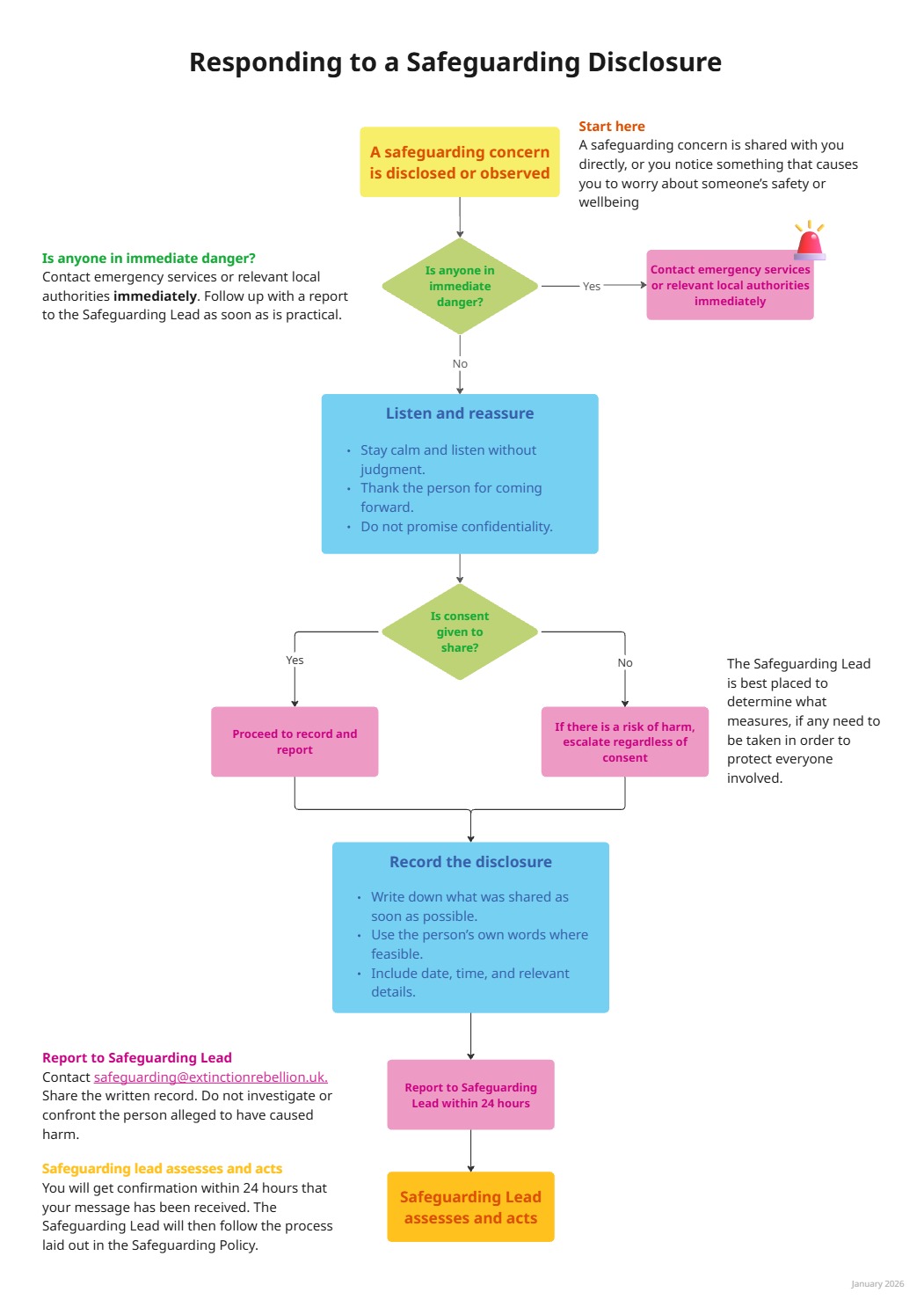
Important: do not approach or confront the person alleged to have caused harm. All concerns must be passed to the Safeguarding Lead.
Where there is an immediate risk of harm, contact emergency services or relevant statutory authorities directly. You can then inform the Safeguarding Lead as soon as is practical.
Safeguarding and Harmful Behaviour
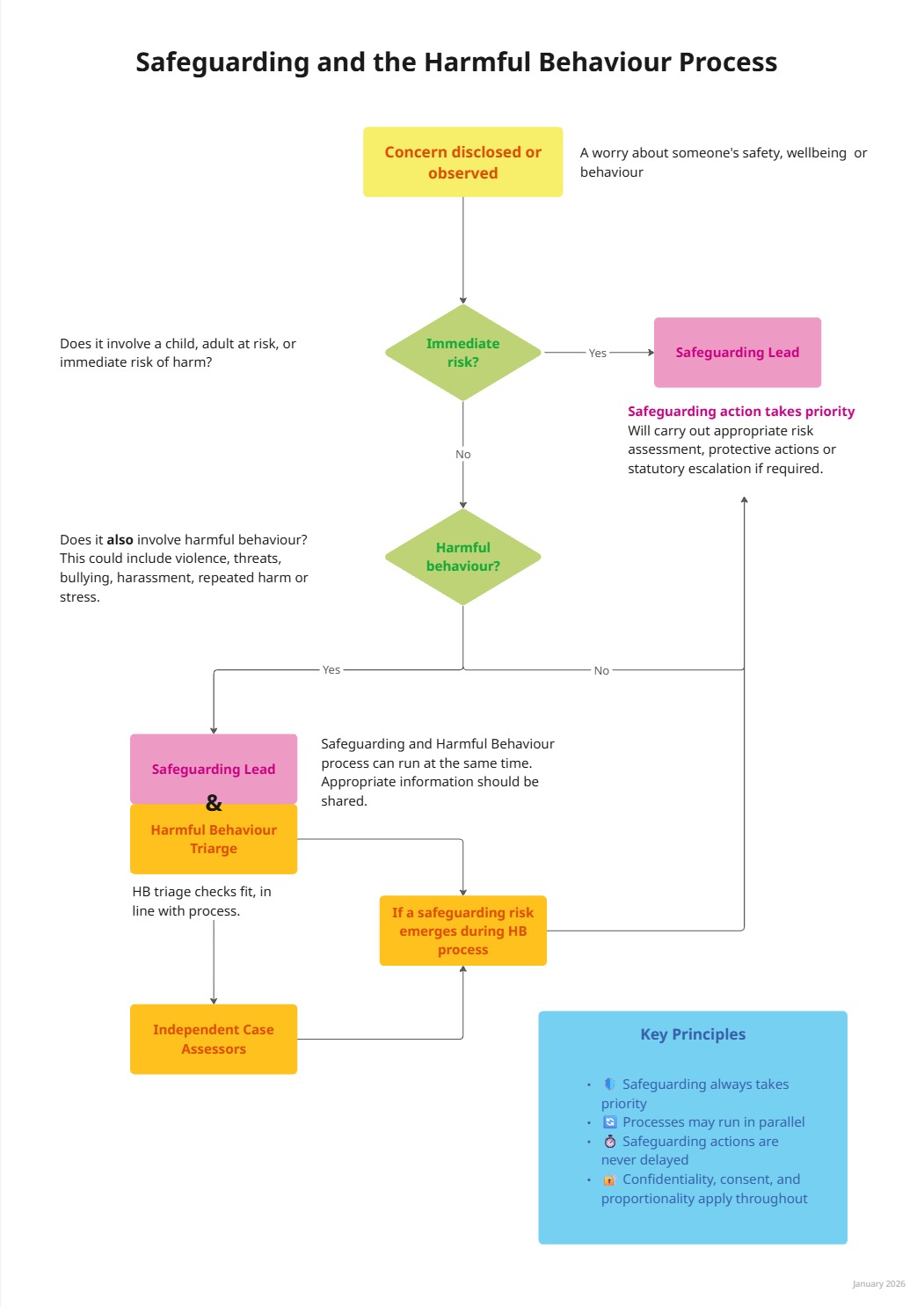
XRUK already has a Harmful Behaviour Process in place. This process is used to handle complaints including violence, bullying or harassment, significant or repeated stress being caused to individuals or groups and where there are persistent or intentional breaches of XRUK’s Constitution, Principles and Values, and Ways of Working.
Where a concern relates to both safeguarding and harmful behaviour, safeguarding considerations take precedence. The Safeguarding Lead may consult with the Harmful Behaviour triage role or case assessors where appropriate, but safeguarding actions will not be delayed by triage or assessment processes. Both processes may run in parallel where necessary, with clear boundaries and information sharing on a need-to-know basis. If a safeguarding risk emerges at any point during a Harmful Behaviour process then the Safeguarding Lead will be informed.
- Safeguarding always takes precedence where there is risk of harm to a child, young person or adult at risk.
- Harmful Behaviour and Safeguarding may run in parallel.
- Safeguarding actions must never be delayed by triage or case assessment.
- Escalation can occur at any point if risk increases.
Safeguarding Process
Safeguarding within Extinction Rebellion UK is held by the Safeguarding Lead, who takes responsibility for receiving concerns, holding each safeguarding case, and coordinating an appropriate response.
The Safeguarding Lead manages the case process end-to-end, liaising as needed with relevant internal teams (such as Legal for specialist advice and any teams directly impacted by the disclosure) and with external agencies where appropriate. They are responsible for assessing risk and determining proportionate precautionary measures, including role restrictions or, where risks cannot be safely mitigated, removal from movement roles or activities. They should use the 6 Principles of Safeguarding, embedded in the Care Act, to guide their actions.
Where safeguarding concerns are confirmed as a result of this process any final resolution or decision should be taken in the best interests of the person who has suffered the abuse or harm and in the best interests of XRUK.
The Safeguarding Lead role may be shared by more than one person, and if the Safeguarding Lead(s) are not available, are unable to act, or where it appears that there may be a conflict of interest in regards to a case referred to them then an appropriate alternative person may be appointed by Rebel Support.
After each case is concluded, the Safeguarding Lead provides an anonymised report to Rebel Support for review and reflection, supporting learning, consistency, and accountability in decision making.