Resources
Useful tools and links to further information.
- Resources - Introduction
- Self Care and Personal Work
- General Support Options
- Support for People of Colour
- Somatic Practices for Connection and Vitality
- Meditations and Reflections for XR work
- Active Hope Sentence Starters
- Oppression, Climate and Racial Justice
- Resources
- Cultivating a Community of Trust
- Oppression, Movement Building and our Relationships as Activists Workshop (OMBRA)
- Listening Circles and other Group Listening Spaces
- Regenerative Culture Videos
- Books
Resources - Introduction
In these pages you will find various resources:
- Information on counselling and listening support;
- Regenerative themed book suggestions;
- XR Regenerative Culture hosted videos;
- Suggestions and information on self care and personal development, see also Rebel Inner Work;
- Somatic practices and meditation;
- An Active Hope practice;
- Resources on oppression and accountability;
- Particular resources for People of Colour;
- Information and guidance for holding listening circles;
- Resources to support healthy working in Book 3, under Tools for relationship building in teams and circles;
- Resources for connecting into nature in Book 2, under Being and Belonging in Nature and 'A Walk with Gaia'.
These resources are offered simply as invitations. If this type of work feels unfamiliar to you perhaps give some things a go before disregarding them. See which ones feel helpful to you, feel free to pick and choose between them.
Perhaps you will have some of your own practices to offer the XR movement or the Regenerative Cultures Circle.
Self Care and Personal Work
These resources are focused on self care and personal work, however you made a wish to try some of them as part of regenerative activities in your circles or local groups.
General Support Options
The Trained Emotional Support Network (TESN) & Climate Psychology Alliance (CPA)
TESN provides supportive functions for both individuals and groups. The realities of the Climate Crisis and potential involvement in protests leave us all needing a little support at some point. TESN and the CPA have a structured set of support offerings ready for you.
How can TESN and the CPA help you?
Click here for information of how to access this support
Other useful apps & services
Give Us a Shout - a 24/7 texting service for stress, anxiety and depression
Calm - meditation app
Headspace - meditation app
Support for People of Colour
The Black, African and Asian Therapy Network
Home of the largest community of Counsellors and Psychotherapists of Black, African, Asian and Caribbean Heritage in the UK.
MNPC (Mindfulness Network for People of Colour & friends)
A grass roots & trauma based organization, endorsing and bridging alternative indigenous methodologies with western science.
Tell Mama
Provides support for victims of anti-muslim hate and also monotors and records anti-muslim incidents and attacks.
Exhale
“Our app creates a space where Black Women can feel seen, heard, and cared for while offering resources that benefit all who seek healing and balance.”
The Black Wellbeing Collective
A community and workplace well-being service for inclusive & intersectional well-being support for lived experiences and the healing of social exclusion.
Synergi
Focuses on the intersection between racial justice & mental health, distress and/ or trauma. "We celebrate the history of activists that have come before us, and in collaboration, we build on this legacy."
Healing Justice London
Is investing in the patterns, postures, and practices we need to enable reverberant impact throughout our communities. "Community infrastructure is our surest path to survival and communities will be the stewards of the spaces and structures we need to support us all."
Somatic Practices for Connection and Vitality
Short films demonstrating the practice of ‘somatic ecology’ by Jenny from XRUK regenerative Culture’s circle.
In these films Jenny invites you to explore with her. She invites you to pause to notice sensation in your body: to feel the ground beneath you, the movement of breathing, the sounds and smells around you. A sensory attunement.
From there she invites you to see how your body directly responds to the environment around you and how parts of the body respond to other parts of the body. We might call this ‘the felt-sense of your living body (soma)’ in resonant connection with the natural world.
In developing these practices people often notice how supported they feel by the natural world. Sleep can improve, healthier food choices increase, creativity flourishes, decision making is more aligned to wellbeing, relationships with others may become more responsive and less reactive. We may start to be in direct dialogue with the whole natural world through the sensing body.
-
Somatic Ecology: Without Words - Pointing to something that’s happening without the need for words. Just as the heart beats without the need for any words.
-
Somatic Ecology: Connecting to the Source of Life, Creativity, Healing, Relationships - Coming into this sensory curiosity as a way into presence.Out of past conditioning and future concerns, we connect to the source of what is new. Open to new creative insights and healing and harmonious relationship.
-
Somatic Ecology: The Body as a Weather-Vane to the Wider Ecology - In reciprocity, correspondence, felt relationship with the environment, other plants, animals and the elements themselves.
-
Somatic Ecology - Surrendering all words of ownership (I, me, mine, ours)separation, domination, can help us feel the natural relational field. Also as we exchange nouns for verbs.
-
Somatic Ecology: The Child of Nature - The intelligence of innate nature-wisdom felt through the body in connection to the rest of the living world.
-
Somatic Ecology: In Resonant Connection with All Life - Feeling the rest of life, as living movements of the (so-called) outside world, inside us. Feeling the living world as kin. Feeling the support and safety of the community on a continuous basis.
-
Somatic Ecology: Liberated to Speak It! - Inviting you, when you feel safe enough to do so, to share with others how you are experiencing the world. What is happening in your body(soma) and felt-sense when you see the birds fly overhead, when you smell the scent of a flower, when you hear the sound of the rain.
-
Somatic Ecology: In Celebration of Innate Embodied Wisdom - In thanks for the willingness to listen to all of life; the land itself, the earth, the smell of the earth, the sounds of the twigs and how it feels directly in the body (my body). The twig breaks out there in the woods and something happens in this body. Let’s amplify and give value to this felt-sense of correspondence.
-
Somatic Ecology: In Solidarity with the Message of Connection - In the resonance you are acknowledging its reality. An embodied and relational solidarity.
Meditations and Reflections for XR work
These are a series of meditations and reflections recorded for XR for support, resourcing and renewal by XR rebel Simon ‘K2’ Mckibbin
The below recordings can be found on Soundcloud under "Extinction Rebellion Meditations & Reflections - Support, Resource & Renew" at: https://soundcloud.com/simon-mckibbin/sets/extinction-rebellion.
Content
-
XR Brief Introduction to these Meditations and Resources
A quick guide to using these practices for emotional strength, clarity, and connection in times of crisis. -
XR Organic Body Grounded Awareness For Soothing
A calming practice to help you feel settled, steady, and connected to your body. -
XR BREATHE Front Line Action Support
A breathing-based support tool for staying calm and focused during high-stress direct action. -
XR Reflective Meditation Resourcing And Preparation For Protest Action
A guided space to gather your inner strength, clarity, and purpose before stepping into protest. -
XR Comfort Meditation Safety Security From Anxiety Fear And Panic
A gentle meditation to ease fear and create a sense of inner safety when things feel overwhelming. -
XR Grounded Aware Presence GAP Short
A short reset to help you feel centred, calm, and steady in any moment. -
XR Grounded Aware Presence GAP Long
A deeper, longer practice for building inner steadiness and resilience from the ground up. -
XR The meaning of Violence and Nonviolence in Co-liberation through Presence
An exploration of how our actions and attitudes can either harm or help collective freedom and justice. -
Soothing Meditation for anxiety and fear & other strong emotions
A gentle guide for calming emotional storms and finding balance inside yourself. -
XR Be Water Reflective Meditation
Inspired by water’s adaptability, this meditation supports fluidity, flexibility, and calm in action. -
XR Treasure Of Your Universe Presence Attunement
A practice to tune into the quiet strength and wisdom already living inside you. -
The Essence of Nonviolent Communication beyond Superficiality and Techniquism
A look at how true connection goes deeper than words — into honesty, empathy, and real understanding. -
Meet Uncertainty and Fear with Safety Resourcefulness Resilience Presence Meditation
A steadying meditation for facing the unknown with courage, adaptability, and inner support. -
Do we stand on thin or thick Ice? Uncertainty Truth and Safety
A reflection on navigating danger and uncertainty with awareness and care. -
Embodied Relational Community Compassionate Connection Attunement
A practice to help us feel and build deep, caring connection with others in our movement. -
Intuition and The Shape of Being Breathed by the Universe
An invitation to listen to the quiet wisdom that guides us beyond logic and control. -
Sensing as a Foundation for Intuition just Noticing Playcise
A playful practice to notice your body’s signals and let them guide your next steps. -
Coming Home to our Sense of Agency Through Presence Attunement
A way to reconnect with your power to choose, act, and care — even in chaos. -
What the Body is Noticing and Letting it Rest In Itself
A meditation to slow down, listen to your body, and let it rest into natural ease. -
Presence as a Protective Cloak of Safety Balance and Wellbeing
A practice to wrap yourself in calm, balance, and steadiness — like a cloak of inner safety. -
Story of the Lost Horse & Something in us Knows how to Come Home Attunement
A story and reflection about how we can trust something deep inside to find the way home. -
Transformative Conflict a creative response to fear and anxiety on the front line
Tools for turning conflict into connection and creativity, even in high-pressure protest situations. -
Being The Change Transformative Community & Language that Connects & Disconnects
Explores how our words and ways of relating shape the kind of world we’re creating together.
Active Hope Sentence Starters
A Spiral of Active Hope
This explanation and following exercise is taken directly from the Active Hope Foundations Training from Chris Johnstone and Madeleine Young. We hope that you enjoy this practice. They say "Please feel free to use, copy and adapt it".
Active Hope is a practice we can apply to any situation. It involves three key steps:
- We start from where we are, taking in a clear view of the reality we face, seeing what we see and feeling what we feel.
- We identify what we hope for, in terms of the direction we’d like things to move in or the values we’d like to see expressed.
- We take steps to move ourselves or our situation in that direction.
Can we have a conversation that helps us meet each other more, support each other in facing disturbing world events, and nourish our capacity to play our part in responding with active hope? Can we have this conversation with others, and with ourselves? Inspired by the work of US author and activist Joanna Macy, and the spiral practice described in her book Active Hope (co-authored with Chris Johnstone), the process described here offers a suggested conversation structure designed to head in that direction. Please see this guide as an invitation rather than prescription, with suggestions to follow and experiment with, while also respecting your choice about how and if you do so.
This practice moves through four stages – Gratitude, Honoring our Pain for the World, Seeing with New Eyes and Going Forth.
Stage One - Gratitude.
We begin with Gratitude as this helps resource us, putting us in a stronger starting point to face the disturbing information. Gratitude also reminds us of our inter-dependence, of ways we receive from others. Evolutionary psychologists identify gratitude as a social emotion that increases our desire to give back to the communities and networks of support we receive from. There are two sides to gratitude – appreciation and thankfulness. To experience appreciation, see what words naturally follow the start of a sentence that begins with the words “I love…” You’re invited to name what you love, appreciate, relish and delight in – this might include people, places, experiences, colours, qualities, or anything else that follows the words ‘I love… ‘. For thankfulness, you’re invited to see what words naturally follow the sentence starter ‘I’d like to thank…’ Who or what have you received from, in ways that support you? See how it feels to name and thank them.
Stage Two – Honoring Our Pain for the World.
When we give attention to what we appreciate and feel supported by, we may also recognise ways these are threatened by conditions in our world. The next part of the spiral invites our witnessing of our own or each other’s concerns, as well as the feelings these may arouse, seeing what words follow this sentence starter: ‘Looking at the future we’re heading into, my concerns include…’
Stage Three – Seeing With New Eyes.
Facing disturbing realities can leave us feeling overwhelmed. If we’re to give our best response it helps to open to perspectives that inspire, empower and resource us, that open us to a sense of possibility. One way of doing this is to see what words follow a sentence that starts with “what inspires me is…”
Stage Four – Going Forth.
Now we move into the last stage of the spiral, which is about looking at what we can do, the part we can play, in the larger story of acting for what we love, addressing our concerns or following what inspires us. Our hopes give us a guide here. See what follows these sentence starters - - - looking at the future we’re heading into, what I deeply hope for is … a part that I’d like to play in support of this is … a step I will take towards this in the next week is.
Active Hope - The Spiral Seven Sentence Starters Exercise
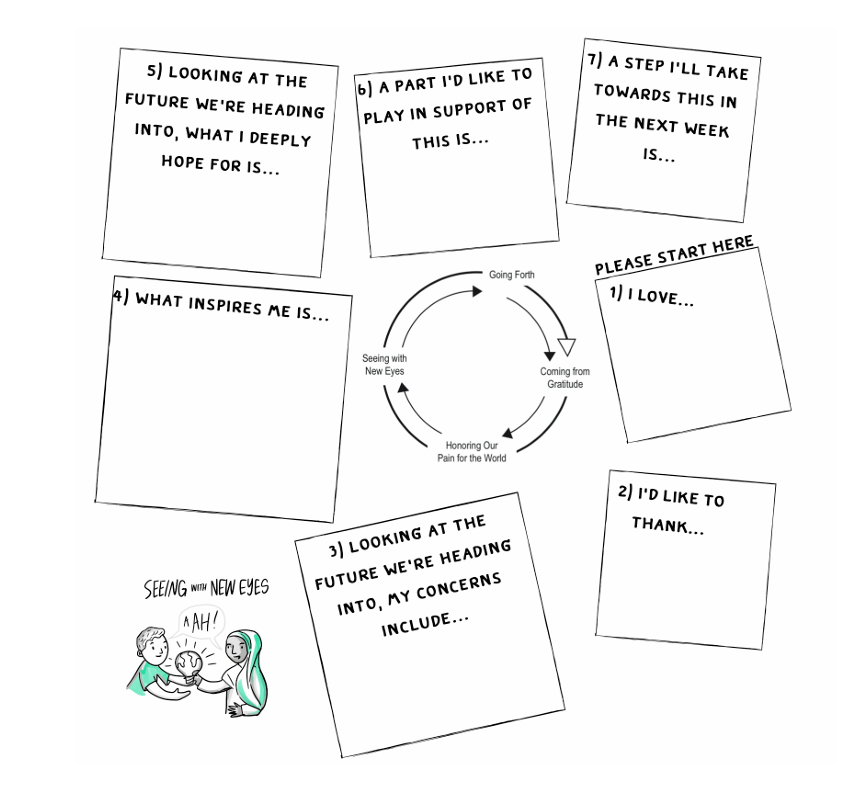
There are 3 ways to engage with this exercise:
Personal Reflection.
Create a space for yourself, within your daily life – turn off any devices or notifications and minimise other distractions as much as you can. Do anything else that feels good for you, to prepare – maybe clearing your physical space, or taking a few deep breaths, or whatever enables this to feel like time for you.
The invitation is to take each sentence starter as a prompt for reflection, recording your thoughts and feelings in whatever way feels best. You may want to use pen & paper to ‘journal’ your responses, you may choose to draw or doodle, or you may wish to record yourself speaking – either audio or video.
Whichever method you choose, say the sentence starters to yourself (either aloud, or in your head), and then let whatever wants to come, come. If you freeze up at any point, go back to saying the sentence starter again and see if anything else comes.
When engaging with this exercise as an individual, it is entirely up to you if you want to set a time limit, or not. For some, it may be helpful to use a timer and choose an amount of time for each sentence starter (5 minutes, for example). Others may prefer to let it take whatever time it takes. You could even experiment with both to see what works best for you!
When you have completed all 7 sentence starters, take a moment to reflect on how this process has felt for you, and to thank yourself for engaging with it, before heading back out into your daily life. Check back in with what you have written, drawn, doodled, or recorded at any point in the future when you would like to reconnect a bit more with yourself.
Paired Active Listening
To do this, you can team up with another rebel , or you could enlist a friend or family member.It is a great way to bond and get to know each other.
We will also be using a different type of listening from the listening we tend to use in daily life. This is called Active Listening and it involves giving all of our attention to what the other person is saying – letting their words soak into us. One person is just talking, and the other is just listening – unlike a ‘normal’ conversation where the talking may go back & forth on any subject. Because we know that we don’t have to respond to what they are saying, we don’t need to give any of our attention to thinking about how we will reply. Instead, we can fully engage with their words with curiosity.
If you are unfamiliar with Active Listening, it can feel quite odd at first, but try sticking with it!
Each person will take a turn to say one of the sentence starters, and then see what words flow naturally for them from there. Silences, noises and gestures are welcome too! Decide whether you want to give a certain amount of time for each response.
Before you start the process, you may want to agree with each other about what level of confidentiality you would like in regards to what you share – or, you could agree to check-in about this at the end of the practice, and to respect whatever you decide on then.
To start the practice, we suggest that one person completes sentence starters 1 and 2, and then you swap over.
Then you can each take a turn at sentence starter 3, on its own.
And then each take a turn at sentence starter 4, again on its own.
It then works well for one person to complete sentence starters 5, 6 & 7, before swapping over for the last time.
When time is up, the listener raises a hand to let the speaker know. That doesn’t mean they have to stop straight away. If they’re in the middle of saying something, they might want to finish that, or say whatever is needed to feel complete enough for now.
When they do finish speaking, it works well to have a moments silence to let their words ripple out - or you may say a simple “I hear you”, or “thank you” - before swapping over or going on to the next sentence starter.
When you have both completed all the sentence starters, find a way to thank each other for all that you have shared, and you may want to have a few minutes chatting about how the process was for you. This is also a good time to check back in with each other about confidentiality – to see if anything has changed for either of you.
Group Active Listening.
In a group, we can follow a very similar process to in pairs, with each person taking a turn to speak, while the others listen. A timepiece can be passed around the group, so that each person is timing for the person next to them.
Or, depending on the size of your group, and the time available to you, you may choose to split into pairs (or 3s) to go through the sentence starters. If so, you can then follow this with a round of active listening (eg. 2 mins each), as a whole group, to reflect on how you each found the process. And, at the end, you can find a way to thank each other for all that has been shared. Again, it is supportive to come to agreement about confidentiality within this group.
Oppression, Climate and Racial Justice
Resources
This section contains resources; courses, articles, web sites and videos that provide education and information on these themes.
These resources are largely concerned with racial and climate justice, for other information relating to diversity, disability and inclusion please see Shelf 9, Access and Inclusion.
To Read
Article on Intersectional Justice.
House of Lords Committee report on the status of Racial Equality following the killing of George Floyd and The Black Lives Matter Protests. Black people, racism and Human Rights.
Transform Harm - website containing articles on transformative justice, a resource hub for ending harm.
Indigenous Peoples Forum - Guardian article centring criticisms of Indigenous Peoples on impacts of climate and ecological crisis.
Unconscious bias - University of Edinburgh EDI (Equality, Diversity, Inclusion) Resources for students and staff.
Dismantling Green Colonialism - online book.
To Watch
Akala: Everyday Racism - Everyday racism and what we can do about it.
John Powell - Othering and belonging.
White Fragility 1 - Author Dr. Robin Di Angelo's long talk on White Fragility.
White Fragility 2 - Short very accessible explainer.
How I learned to stop worrying and love discussing race - Ted Talk by Ray Smooth, New York Hip Hop Radio Host.
Cultivating a Community of Trust
Intentions for cultivating a community of trust and inclusion, taken from The Compassionate Activist by Lucy Draper-Clarke.
Try it on
Be willing to “try on” new ideas or ways of doing things that you might not prefer or be familiar with.
Practice self focus
Attend to and speak from, your own experience and responses. Do not speak for a whole group or express assumptions about the experience of others.
Understand the difference between Intent and Impact
Try to understand and acknowledge impact. Denying the impact of something by focusing on intent is often more destructive than the initial interaction.
Practice “Both/And”
When speaking, exchange “and” for “but” . This acknowledges and honours multiple realities.
Refrain from blaming and shaming self or others
Practice giving skillful feedback.
Move up/Move back
Encourage full participation by all present. If you tend to speak often think of “moving back” and vice versa.
Practice mindful listening
Try to avoid planning what you might say when other people are talking. Be prepared to fully listen, be willing to be surprised, to learn something new.
Confidentiality
Take home learnings, but don’t identify anyone but yourself. If you want to follow up something someone said during a session, ask first and respect their wishes.
Right to pass
Everyone can choose to “pass” if they don’t wish to speak.
Oppression, Movement Building and our Relationships as Activists Workshop (OMBRA)
This workshop has been widely run throughout XR, both in the U.K. and around the world.
Register for the next workshop date here.
Overview of the workshop
The purpose of this workshop is to build a solid foundation for understanding issues of oppression and division to help to build and protect our movement.
Progressive movements have often been impeded by the divisions that arise when issues of oppression go unaddressed, or are not addressed well. These divisions may be internal or external. Internal division is when sections of a movement become so preoccupied with their difficulties with each other that they lose focus on their original mission. External division is when a movement forms, but the movement doesn’t know how to engage with or relate to the wider population, so it remains narrow and limited.
Mistreatment and oppression break trust and break relationships (between individuals and between groups) and so get in the way of us working together towards common goals.
This workshop explores the relationships between emotional hurt, mistreatment, oppression and division – and how these have come to form a self-perpetuating system. The workshop shows how we have all been co-opted into this system, and why a culture (or tone) of punishment and blame around these issues is part of what locks the system in place. The workshop shows how we can begin to create the conditions necessary to undo this confusing tangle, so we can work together to dismantle an inhuman system which serves no-one's real interests.
Please contact ombraworkshop@gmail.com if you would like to find out when this workshop is running or if you are interested in being mentored to run this workshop.
Listening Circles and other Group Listening Spaces
What is a “Listening Circle”?
There are several types of “listening circle”, in general it is an in-person or online space where participants are invited to share their thoughts and importantly their feelings in relation to a specific situation or topic. Usually the group will be no bigger than around 10 people, if larger people would be invited into smaller groups to support a sense of trust and to enable everyone to have an opportunity to speak. There are usually one or two facilitators whose job it is to “hold the space”, i.e. to direct the structure of the sharing, to keep time boundaries and to respond sensitively to the needs of individuals and the whole group.
Starting the Circle
The circle may start with a short check-in or participants just sharing something simple in the chat. A listening circle is not a conversation or an exchange, instead people take turns to speak uninterrupted, often for a specific time (3,5 whatever minutes). It is an important part of the process for the speaker to be given the full attention of the other members of the group.When a participant has come to the end of their allotted time or has finished what they want to share, the facilitator can simply thank the person, or invite a pause for the rest of the group to consider what is being said, or sometimes reflect back or respond with a few words to what has been spoken.
No advice or solutions
There is no attempt to solve, give advice or to give an opinion on what has been shared. If other members of the group start to share advice or aim to start a discussion around what someone else has shared, the facilitator will gently remind the group that this is a space for people simply to be heard.
Another person in the circle can then take a turn to speak, sharing their feelings and experience. The opportunity to share is passed around the circle until everyone who wants to speak has done so, usually people are not pressed to speak if they simply want to listen.
After one round of sharing there will often be another round and the facilitators will often invite a short check out usually including an opportunity for participants to share how they have found the circle.
Responding to the particular need
“Listening Circles” can be offered or structured in relation to a perceived need . So in XR sometimes a listening circle may be offered as a support for rebels to manage the various challenges of being alive in the world as it is and the difficulties of being an activist. Sometimes a listening circle may be offered in relation to some difficulty that has happened in or to a circle or group, or to the movement as a whole.
In some listening circles people may be simply invited to share whatever is on their heart and mind at the time or there may be a specific topic.
Example of Facilitator’s introduction to a listening circle
As in all groups facilitators would check out inclusivity needs.
- Listening Circles offer space to think and feel; a haven from busyness and activity. Sharing feelings in a supportive setting helps to build our resilience to help us continue our work in a sustainable way.
- We can share our feelings about the climate and ecological crisis, our work as climate activists, or whatever is in the forefront of minds and hearts.
- We will be co-facilitating, and participating. Our role is to pay attention to the process and to keep us to task.
- We are not experts or leaders. (Facilitators share the structure and timing of the group, e.g 90 mins with check-in 2 rounds of sharing and check out).
- This is not a therapy group, so bring what you feel comfortable bringing. We aren’t rushing away at the end, so we’ll be available for anyone who wants a separate chat. (N.B. It is important that facilitators don’t take responsibility for supporting individuals after a listening circle but rather signpost them to support e.g. TESN tesn@tesn.uk, or the Climate Psychology Alliance).
- We have no intention of leading you to any conclusion or course of action.
- There is an aim for this to be an open, respectful and confidential space where people can feel safe enough to express their views.
- The focus is our thoughts and feelings rather than what we are doing or think people should do. All feelings are welcome.
We have some ground rules we would like you to agree to:
- Please listen respectfully when people are talking and resist temptation to multitask.
- We would ask that people stay on screen unless neurodiverse preferences or other needs make that uncomfortable/not possible.
- Please speak from our own experience, using I statements when appropriate.
- Please respect other’s views, not trying to assert a point of view
- Confidentiality - please do not share anyone elses material outside this circle.
- Are there any other ground rules group members would like?
Examples of different kinds of listening circles.
Here are a few examples of different kinds of listening spaces.
A grief circle is a listening space where people are invited to share their grief. This may be personal or relating to a particular situation or our grief about the earth.
Some of us have a strong resistance to feeling and sharing our sadness about our lives and the plight of the planet. However, it is important for our emotional resilience that we find ways to do this. A grief circle is one place that we can support each other with that.
The artist Chris Jordan believes that when we try to be cheerful and suppress our grief for the world, we’re also suppressing our love for it. “Grief and love can be seen as inseparable twins,” he writes “When we hold grief at a distance, our love becomes inaccessible; and when we embrace grief, we reconnect with the essential aspect of our being that has gone missing.”
Professor of environmental humanities Jennifer Atkinson says “Eco-grief and anxiety arise from the recognition that our existence and wellbeing are entwined with other lives — an insight that’s fundamentally missing from our modern worldview and consumer way of life. Remembering how intimately our lives are bound up with others will be key to undoing this legacy and ensuring our collective survival.”
A climate cafe is a listening circle where participants are invited to share feelings about the climate and ecological crisis. Within XR these circles have been run both for Rebels and for the general public to encourage engagement with the Climate and ecological crisis. They are set up in a particular way and usually involve serving drinks and cake like a cafe. If online people can be invited to bring their own!
This particular form of listening space has been developed by the Climate Psychology Alliance and they run circles, and offer training and supervision for others who are running circles. https://www.climatepsychologyalliance.org/index.php/component/content/article/climate-cafe-listening-circle?catid=16&Itemid=101
XR Health and XR Buddhists both offer Climate Cafe’s.
Empathy Circles
Empathy Circles are a particular kind of listening space where there is a next step for the participants to connect with each other. Instead of simply “ listening respectfully” to what people say as they take turns around the circle, the speaker chooses one listener who reflects back to them what they have heard the listener share. This process tends to lead to the speaker feeling truly listened to in a profound way. Empathy circles have been developed by Edwin Rutsch.
They were run through XR Global for a time but they are not run through XR at the moment.
How to do a basic Empathy Circle
In a circle or break out room of 3-5 participants.
- The first person selects who they will speak to.
- They speak for whatever comes up for them for a set time (3-5) minutes. There may be a given topic or not.
- The listener reflects back what they are hearing until the speaker feels heard and understood.
- It is then the listener’s turn to select who they want to listen to reflect back to them.
- Everyone holds the process by monitoring and sticking to the steps. Often groups decide to have facilitators to hold the process.
Speakers
- Pause often to give the listener a chance to reflect back what they heard.
- After speaking and receiving the reflections from the listener, you may say “I feel fully heard" to show that you are finished.
Active Listener/Reflector
- In your own words reflect back the essence of what you hear.
- You can ask the speaker to pause from time to time to give you a chance to reflect back .
- It’s important not to ask questions or judge, analyse, advise or sympathise. Silent Listeners
- Listen and be present to the exchange between the speaker and reflector listener. It is advisable to get some experience of being in Empathy circles before running one. There is also online training available. https://www.empathycircle.com
Empathy Pairs
Empathy pairs/trios based on empathy circles, can be useful for a “deeper check-in” in an ordinary meeting or at the beginning of a workshop as a way of contributing to a sense of community and safety.
-
Introduce yourself if necessary, Choose A and B .
-
Sit quietly together for a minute or two and just noticing what is here for you…feelings, thoughts, mood, as best you can, being open to what is stirring in you.
-
Person A shares for 4 minutes as much as they are comfortable with in relation to how they are currently feeling.
-
Person B says nothing but actively listens with heart and body to really try and understand how it is for A at this time…keeps time, signals when one minute is left.
-
Then B feeds back what they have heard /understood, not solving or advising or sharing their own version of the situation. Make it tentative e.g. 'it sounds like...' (2 mins)
-
Then A clarifies anything not quite right and adds anything important. (2 mins) B listens again.
-
Then B feeds back anything additional they have heard and A clarifies anything necessary. B checks with A whether they have felt heard. (3mins)
-
Pause, then doing the same the other way around.
-
Timings can be changed to suit the situation.
Regenerative Culture Videos
XR Regenerative Cultures recordings (Youtube)
These are recordings that the Regenerative Cultures Circle hosted which were part of the Fridays for Regenerative Futures series of weekly workshops. Many of the sessions were not recorded to allow participants to feel more comfortable to share but these gems were recorded for prosperity, enjoy!
- Roots of Regenerative Cultures
- Deep Listening
- Exploring Intuition
- Storytelling for Effective Activism
- Sacred Activism
- Touching Earth
- Pranayama & Yoga Nidra
Books
This is a list of various books dealing with ideas around regenerative cultures in their widest sense.
Designing Regenerative Cultures - Daniel Wahl
In this remarkable book, Daniel Wahl explores ways in which we can reframe and understand the crises that we currently face and explores how we can live our way into the future. Moving from patterns of thinking and believing to our practice of education, design and community living. The book covers the finance system, agriculture, design, ecology, economy, sustainability, organizations and society at large.Patterns of thinking and believing, to our practice of education, design and community living.
Cultural Emergence - Looby Macnamara
Cultural Emergence is an invitation to create cultures of personal leadership, collective wisdom and Earth care. Emergence initiates breakthroughs that expand our thinking and enable us to build personal and collective resilience, and embody new ways of being and interacting. It nourishes and empowers us to design the world we want to live in.
Burnout Immunity - Kandi Weins
An essential guide for all those seeking to fortify themselves against the all to common threat of burnout.
Saving Us - Catherine Hayhoe
Argues that facts alone are not enough to convince people about climate change, and instead we must focus on having personal conversations rooted in shared values to foster collective action.
Climate, Psychology and Change - Steffi Bednareck
An exploration of the psychological and emotional dimensions of the climate crisis
Holding the Hope - Linda Aspey
The chapters in this thought-provoking, honest, moving and sobering book explore the frameworks, theoretical constructs and ways of working talking therapists have devised to hold hope and build agency in the face of this immensity of complexity, uncertainty and injustice.
Emergent - Miriam Kate McDonald
Emergent tells us what we long to hear - that we are nature. Miriam challenges the contemporary narrative of Human Vs Nature, which has enabled us to dismantle the very ground upon which we stand. This book tracks the journey of that separation and reminds us of our true nature. It reminds us to tend our gardens as all living creatures do, as an integrated part of the beautifully complex and dynamic ecosystems we inhabit
The Spell of the Sensuous - David Abram
The spell of the sensuous explores the earthly, ecological dimensions of sensory experience and language. The book uses diverse sources like phenomenology, shamanism, and magical traditions to show how our cognitive abilities are intertwined with the environment. It challenges the separation between "human" and "more-than-human" worlds and suggests a recovery of our senses can lead to ecological sanity. A philosophical exploration of human connection to nature: The book explores how humans have become separated from the natural world and suggests ways to recover this relationship.
Sensitive; the power of the thoughtful mind in an overwhelming world - Jean Granneman and Andre Solo
Highly sensitive people:
- Have a heightened sense of empathy
- Tune into subtle details and make connections that others miss
- Are often wonderfully creative Through fascinating research, expert storytelling and practical insight, this book will teach you how to unlock the potential in this undervalued strength and leverage it in your relationships, your work and your life.
How to Listen - Kate Columbus
From opening up a conversation with someone who might be struggling, to how to use gentle encouragement to help others share their stories, How to Listen demonstrates the power of listening without judgement and draws on the extensive experience of Samaritans in offering practical advice to apply to your own life.
Active Hope - Joanna Macy & Chris Johnstone
The challenges we face can be difficult even to think about. Climate change, the depletion of oil, economic upheaval, and mass extinction together create a planetary emergency of overwhelming proportions. Active Hope shows us how to strengthen our capacity to face this crisis so that we can respond with unexpected resilience and creative power. Drawing on decades of teaching an empowerment approach known as the Work That Reconnects, the authors guide us through a transformational process informed by mythic journeys, modern psychology, spirituality, and holistic science. This process equips us with tools to face the mess we're in and play our role in the collective transition, or Great Turning, to a life-sustaining society.
Braiding Sweetgrass - Robin Wall Kimmerer
A hymn of love to the world, Robin Wall Kimmerer has been trained to ask questions of nature with the tools of science. As a member of the Citizen Potawatomi Nation, she embraces the notion that plants and animals are our oldest teachers. In Braiding Sweetgrass, Kimmerer brings these two ways of knowledge together. Drawing on her life as an indigenous scientist, a mother, and a woman, Kimmerer shows how other living beings - asters and goldenrod, strawberries and squash, salamanders, algae, and sweetgrass - offer us gifts and lessons, even if we've forgotten how to hear their voices. For only when we can hear the languages of other beings will we be capable of understanding the generosity of the earth, and learn to give our own gifts in return.
The Biology of Wonder - Andreas Weber
In The Biology of Wonder, scientist Andreas Weber reframes this fundamental enigma by arguing that all living beings, like humans, are not biological machines, but living, creative agents fueled by meaning and expression. Weber proposes a new approach — the development of a “poetic ecology” — which intimately attaches our species to every being and underpins the entire range of human experience. He argues that feelings and emotions, far from being superfluous to the study of organisms, are the very foundation of life. .
Mindfulness — Finding Peace in a Frantic World - Mark Williams & Danny Penman
Rediscover peace and contentment, for there is a deep well spring living inside us all no matter how trapped and distraught we might feel. This wellspring promotes a deep seated authentic love of life, seeping into everything you do and helping you to cope more skillfully with the worst that life throws at you. Remember how to live a good and joyful existence. Mindfulness meditation is used to reveal our innate joie de vivre. This can prevent feelings of anxiety, stress and sadness from spiraling downward into prolonged periods of unhappiness of exhaustion.
The Serviceberry - Robin Wall Kimmerer
As Indigenous scientist and author of Braiding Sweetgrass Robin Wall Kimmerer harvests serviceberries alongside the birds, she considers the ethic of reciprocity that lies at the heart of the gift economy. How, she asks, can we learn from Indigenous wisdom and the plant world to reimagine what we value most? Our economy is rooted in scarcity, competition, and the hoarding of resources, and we have surrendered our values to a system that actively harms what we love. Meanwhile, the serviceberry’s relationship with the natural world is an embodiment of reciprocity, interconnectedness, and gratitude. The tree distributes its wealth―its abundance of sweet, juicy berries―to meet the needs of its natural community. And this distribution ensures its own survival.
The Compassionate Activist - Lucy Draper-Clarke
We are living through a time of environmental and humanitarian disasters, underpinned by a crisis of consciousness. Communities are polarised and people isolated, despite our technological connectivity.The Compassionate Activist is for changemakers, meditators and activists, offering guidance to transform our wounded world from the inside out. What can we do in the midst of uncertainty and overwhelm? Attend to what is within us and around us, moment-by-moment.This book is for all who see activism as a relational practice built on an ethic of care. It calls for engagement inspired by love not hate, and the mobilisation of communities through solidarity not separation.
White Fragility - Robin DiAngelo
Robin DiAngelo explains that white people are used to viewing themselves as “raceless” or the “default” race, and as such insulate themselves from feelings of racial discomfort. She describes racism as systematic rather than overt and conscious.
How to be an Antiracist - Ibram Kendi
Professor Kendri argues that “not being racist” is not sufficient in the struggle against racism. He proposes that racism isn’t just about hatefulness or ignorance but a structural phenomenon in society.
Me and White Supremacy, Combat Racism, Change the World and Become a Good Ancestor - Layla Saad
This book written for white readers is structured into a 28 day guide. It poses questions to the reader. The book aims to aid readers to identify the impact of white privilege and white supremacy in their lives.
Hospicing Modernity - Vanessa Machado de Oliveira
This book is not easy: it contains no quick-fix plan for a better, brighter tomorrow, and gives no ready-made answers. Instead, Vanessa Machado de Oliveira presents us with a challenge: to grow up, step up, and show up for ourselves, our communities, and the living Earth, and to interrupt the modern behavior patterns that are killing the planet we’re part of. Driven by expansion, colonialism, and resource extraction and propelled by neoliberalism and rabid consumption, our world is profoundly out of balance. We take more than we give; we inoculate ourselves in positive self-regard while continuing to make harmful choices; we wreak irreparable havoc on the ecosystems, habitats, and beings with whom we share our planet. But instead of drowning in hopelessness, how can we learn to face our reality with humility and accountability?
Outgrowing Modernity - Vanessa Machado de Oliveria
A workbook to follow up on her previous book Hospicing Modernity.
Coyote's Guide to Connecting with Nature - Jon Young, Evan McGown, Ellen Haas
Coyote mentoring is a method of learning that has been refined over thousands of years, based on instilling the need-to-know. Coyote's Guide to Connecting with Nature, 2nd Edition reveals this approach and what happens to student and teacher during the mentoring process. Strategies like questioning, storytelling, tracking, mapping, and practicing survival skills will inspire student curiosity and encourage self-sufficiency. Background information will help parents, teachers and others feel more confident in introducing children to new ways of experiencing and learning about the natural world.
As naturalist Jon Young writes in the Introduction, "Experience has taught me that Coyote Mentoring, working on so many levels, is by far the most effective learning and healing journey I have yet to encounter. I have seen people fully connect to the birds of their landscape, discovering hawks, foxes, and owls with the help of birds and other animals."