
Guide: Polis for Participants
How does Polis work?
- You get a link to a Polis discussion on a particular topic. Click-by-click you will see a number of different statements for you to read and react to.
- You can Agree, Disagree, or Pass / Unsure on each statement.
- You can then suggest new statements, and then everyone can vote on those too.
You won't be able to vote on your own statement. (If your own ideas do show up, this is a glitch, so please do report this to the Assemblies team.)
Polis uses maths (algorithms) to see where people agree and disagree on issues. It groups people into clusters based on how they vote and not who they are. This helps set priorities fairly. If there are demographic statements, these help cluster groups based on specific characteristics, e.g. age, location, gender etc. Read the XR Polis privacy info here.
The most powerful part: Polis highlights statements that different groups agree on, and where they disagree. Learning where people's opinions align, allows for fairer and more acceptable decision making. More info on the history and use of Polis here.
Adding Your Own Statements
This is your chance to contribute new ideas for everyone else to vote on. Remember, people will be replying with 'Agree', 'Disagree' or 'Pass / Unsure'
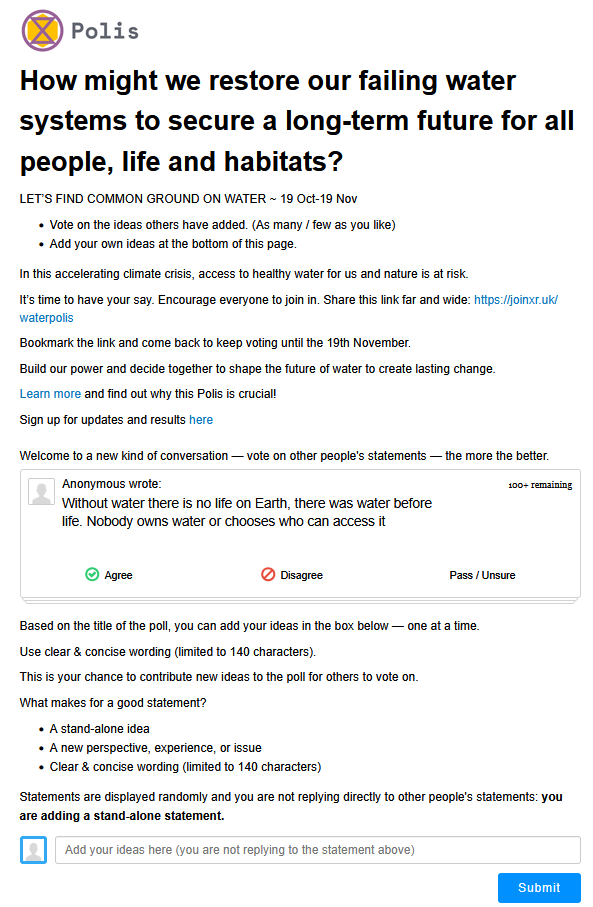
This is an example of what you will see when you get the link. Notice you have two ways to take part. You can vote on others'ideas, or add your own by scrolling further down.
What Happens Next
- Polis collates your anonymous responses and analyses the results, learning as the discussion goes on.
- The most popular ideas will be displayed more often, for deeper exploration and consensus building around those ideas.
- The results are then downloaded by organisers as reports. These will be shared on the Rebel Toolkit, via email and across social media.
- If many people have taken part, that gives weight to those ideas and makes them more representative of the wisdom of the crowd. We then encourage everyone to share the results to lobby politicians, organisations and companies. The strength of opinion depends on the greatest possible participation levels.
How Polis Respects Your Privacy
- There is no registration process.
- It is anonymous.
- Your responses to demographic questions help identify which groups vote in particular ways; this helps with fairer decision-making.
- Your computer has its own address - known as the IP address; this information is deleted from our XR servers after 5 days. We have to keep that information for this short time in order to protect us all from spammers.
- If there are too few participants, demographic questions (such as age, gender, location) could identify you. These will be deleted if there is any risk of breaking anonymity.
- Read XRUK's full privacy policy.
Moderation
We use moderation to prevent abuse, and other tools when needed, however the privacy of participants has always been a key concern for XR technical teams working with Polis.
There are trained dedicated Moderators for every Polis poll. They help keep the poll simple and ensure protection of privacy.
Sometimes participants add statements that have two options, in which case Moderators will reword this into two statements, both of which can be voted on. There may be repetition of ideas; Moderators will reject those statements that are too similar.
If you have any questions or need support - contact the UK Assemblies Team.