
Movement Survey 2026
A short survey developed by the 'Pathways' circle was sent out via the XRUK email list in April/May 2026.
A second longer anonymous survey developed by the 'DAIC (Data Analytics and Insights) circle was also offered.
Experience and barriers study
At the end of the short survey, respondents were offered the opportunity to complete a longer (15min) anonymous, ethically approved, academically-rigorous survey. This was designed to explore views on the climate crisis, past engagement with Extinction Rebellion, thoughts on police actions during protests, and future involvement intentions.
For this survey, there were 705 'valid' responses. The results were compared with data from the 2024/2025 survey.
Results and Conclusions
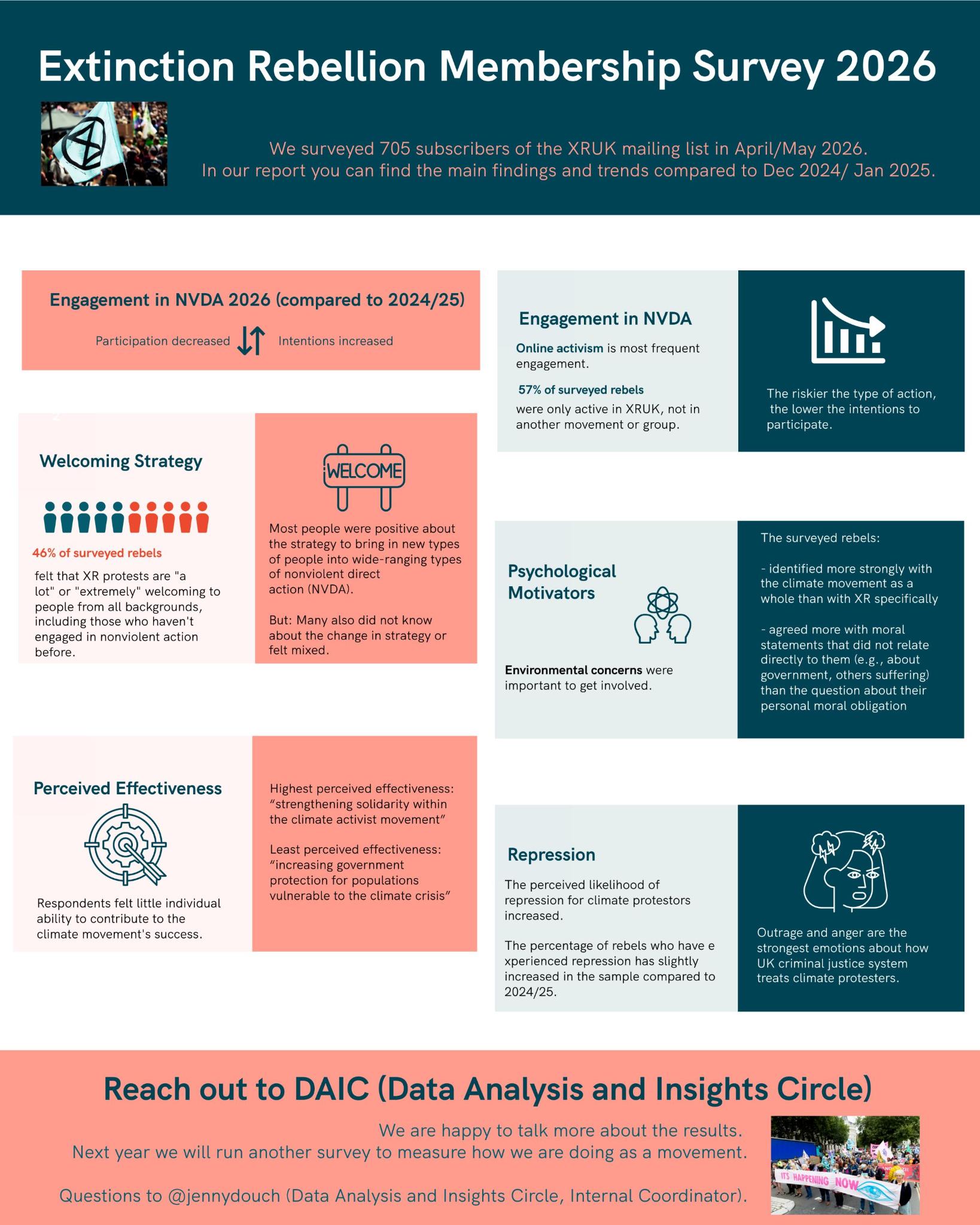
The visual summary below shows key findings around engagement, our welcoming strategy, perceived effectiveness, psychological motivators, and repression. You can read the full report here: XR Membership Survey Report 2026.pdf
Most respondents were long-term XR members drawn from across the UK, with the largest numbers in the South West, the South East and Greater London.
Over two-thirds had engaged in online activism in the past year, although participation in most XR activities was slightly lower and less frequent than in 2024/25. Respondents expressed greater willingness to take part in future climate actions, but this declined for higher-risk activities. Almost two-thirds felt morally obliged to join protests in support of pro-environmental policies. They also regarded XR as somewhat effective in achieving climate goals, and particularly in strengthening solidarity within the climate activist movement.
Respondents believed that the policing of climate protest continues to grow more repressive, which is consistent with concerns raised in XR’s earlier research. Many had experienced repression first-hand: around a third reported being subject to surveillance, and 14% reported having been arrested. When reflecting on the treatment of climate protesters, respondents most commonly described feeling outrage and anger.
You can read more about previous surveys and research here: